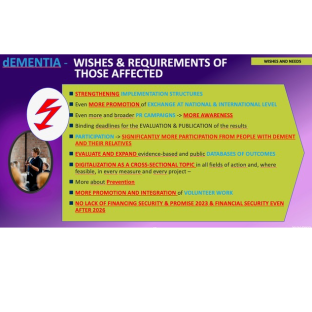
Dementia is becoming one of the major social, cultural and economic issues of our society and our time. Not just here in Germany, not just in Europe, but throughout the world. The World Health Organization (WHO) outlines a dementia epidemic that will spread its octopus arms worldwide if we do not act in a timely and decisive manner. The issue is on the agenda in all societies in which many very old people live - from Japan to the United States of America, in China and in Switzerland. It happens to all of us: first we made sure we lived longer, and now we are feeling the consequences.
The "fourth age", old age, which was once an exception, is becoming a mass problem and neurodegenerative diseases are increasingly finding their way into significantly younger phases of life. It is no exaggeration to say that in the next few decades, one of the great humanitarian challenges for ageing societies will be to be able to care for and support the growing number of people in need of care, especially the growing number of people with dementia that this last stretch of life is not just torture for those affected and their relatives. Raising expectations for a further medically enabled extension of life is certainly the rule in our society today, but at the same time, we must recognise that we are not yet able to cope with the social consequences of this possible medical triumph. One (wrong) answer is obvious. It is already being propagated in the media: The “problem” caused by advances in medicine should be overcome by medicine. It doesn't take much imagination to predict: "This will most likely be difficult or even impossible." And so, the pressure increases. One thing is currently obvious: As the number of people diagnosed with dementia increases, so does the number of profiteers. The care sector can expect large growth rates.
The medical dementia specialists have “good” (financial) prospects, and the pharmaceutical industry can expect growth spurts in the dementia sector. But another thing is also noticeable: the long-standing trend of pushing the issue of dementia primarily into nursing and medical ghettos and controlling it, there, has failed. In fact, huge profits are already being made from those who are affected, many who are helpless. But who are the winners? Under no circumstances are those affected and/or their relatives the winners! So, we should ask ourselves the critical question together: “Can things continue to work like this in the long term?” Isn't it time to discover the social, human side of dementia? Whether we succeed in adopting humane, people-friendly ways of dealing with dementia will determine our social and cultural future. It may also be a matter of trying to reverse the direction of thinking and asking the question of whether we are fundamentally going in the right direction. It's also about letting those affected have their say, instead of excluding them.
On many levels, some of the self-proclaimed expert systems and living environments surrounding dementia, old and new concepts for the correct handling of dementia are constantly being propagated and developed. “Evaluate”, “brainstorm”, “frame”, “include”, “validate” are the daily business. Many clever minds produce a lot of paper for large cupboards or "reinvent the wheel” for the umpteenth time, consciously or unconsciously. All too often, it is also a culture of alibi; especially in today's social media structures. Unfortunately, constructive criticism from the grassroots or those affected is not welcome. Especially not from those affected and their relatives. But the sad realisation is that very few of the expensive concepts, both good and bad, or the project results will see daylight, in practice. They end up being another "good approach". There is a lack of money everywhere, there is a lack of political will and there is a lack of people with the required expertise - in and from practice.
There is a lack of the necessary empathy and commitment to turn the pure theory into tangible and visible benefit for those affected. Well-trodden paths are more comfortable and supposedly less risky, and thinking outside the box costs time - which people supposedly don't have, or perhaps don't want to invest. Nobody in our success-spoiled society wants to make a mistake or take responsibility. Especially not when it comes to health. All of this occasionally reminds me of the zealous Lilliputians who tried to bind, captivate and control the giant Gulliver with a thousand threads. Yes, efforts also deserve our respect and appreciation; but will that be enough in the end?