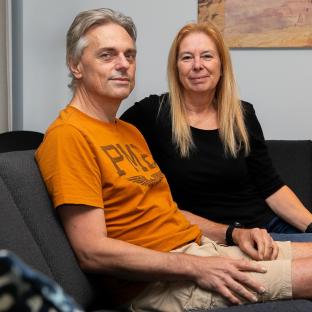
I would like to share with you the text of an interview with Geert and myself regarding a project we worked on together. It concerns a “clear language box”, a communication tool for staff at the Jessa Hospital, where I used to work:
From lived experience to better communication in healthcare
Members of the European Dementia Carers Working Group (EDCWG) of Alzheimer Europe regularly share their lived experience to help improve research, policy and care practices across Europe. By bringing the perspective of carers into projects and initiatives, they help ensure that the realities of living with dementia are better understood.
Annick Germeys, a member of the EDCWG, recently contributed her experience to a project focusing on communication in a hospital environment. Together with her partner Geert Mathys, who lives with young onset Alzheimer’s disease, she helped test and reflect on tools designed to support communication with patients who experience difficulties understanding or expressing language.
The initiative was developed by former colleagues of Annick at Jessa Hospital in Hasselt: Elke, a social worker with a hearing impairment, and Lotte, patient experience officer. Their project, the “Clear Language Box”, brings together practical tools to support healthcare professionals in communicating with patients who experience communication barriers, such as people with dementia, hearing or visual impairments, autism, or patients who speak another language.
At the launch of the project, Annick Germeys and Geert Mathys were interviewed by Brigitte Celis. For Annick, this contribution fits fully within her commitment to make the voices of carers heard, at regional, Flemish and European level.
Clear language, big impact
At Jessa Hospital in Hasselt, a set of tools was developed to support healthcare professionals in communicating with patients who experience communication difficulties. One of these tools is a language card-set with clear pictograms.
But how do patients and their families experience such a tool? We asked Annick Germeys and her partner Geert Mathys.
What challenges do you encounter most?
Annick: “For Geert, spoken language is particularly affected. He increasingly struggles to find the right words, which makes conversations more difficult. Fortunately, he can still read short texts.”
Geert: “I still read the news and the stock market reports.”
How do you deal with this change?
Annick: “When you receive the diagnosis, a grieving process begins. Yet after a few weeks, Geert made a mental switch. Together we try to focus on what is still possible and continue doing things we enjoy. There is life after the diagnosis.
Geert sometimes misses the appreciation he used to receive in his professional life, but he has found new activities that motivate him, such as sculpting and running. I often look for tools or solutions that help us continue doing the things that matter to us.”
What kind of tools do you mean?
Annick: “It’s not only about tools, but also about people who are willing to think along with us. We love travelling, but the busy environment of an airport can be very stressful for Geert. Fortunately, Brussels Airport has staff who assist people with disabilities, allowing us to follow a calmer route through the airport.
At the art academy and the athletics club as well, instructors take his situation into account. Technology also plays an important role in our daily lives. Our shared digital calendar partly replaces Geert’s memory, and during his running training I can follow his location through a tracker. He can also see where I am.”
Is the “language card-set” also such a tool?
Annick: “Absolutely. I helped develop it and I’m very happy that the hospital involved people with lived experience. That is essential, because people who live with dementia every day often know very well what works and what doesn’t.
The pictograms in the box are meant for different groups of patients. Geert recognises some of them immediately, while others are more difficult. That is why I would actually like to have such a card set myself, so we could practise together.
When I accompany Geert to the hospital, I often help with communication. But as a carer, you cannot always be present during examinations. That can be difficult, because even simple instructions are sometimes hard for him to follow.
That is why I find it very valuable that the clear language box also contains tips for healthcare professionals on how to communicate with patients who experience language difficulties. One additional tip I would certainly like to add: never talk over the patient’s head, and make use of the information and support that carers can provide.”
Five tips for clear communication
1. Use simple words. Avoid medical jargon and keep sentences short.
2. Use body language and eye contact. Support your message with gestures and pay attention to the patient’s reactions.
3. Use visual support. Pictograms, drawings or examples from everyday life can help.
4. Give time. Allow the patient to respond calmly, without pressure.
5. Repeat and clarify. Provide additional explanation when needed.