Alzheimer Europe is pleased to introduce issue 51 of the Dementia in Europe magazine! There has been much valuable work taking place across Europe in the domains of policy, research, culture and care, and we are delighted to showcase these in our magazine.
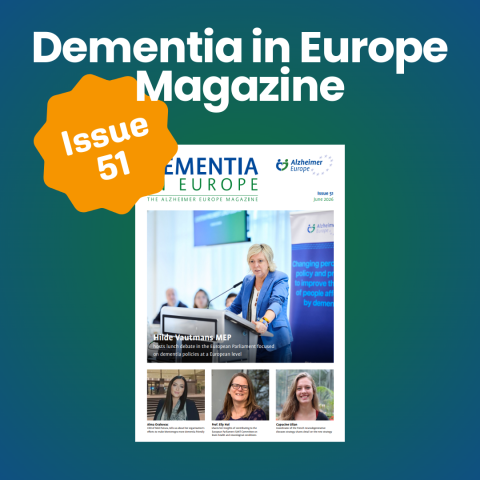
Beginning with the Alzheimer Europe section, we open by providing highlights from our lunch debate in the European Parliament on dementia policies at an EU level, hosted by European Alzheimer’s Alliance Co-Chair, Hilde Vautmans MEP (Belgium). Our sincere thanks to her and all speakers and attendees for an interesting session! Staying with our events, we look at our most recent Alzheimer’s Association Academies, which covered health technologies and reimbursement, supporting and involving carers in policy, advocacy and research, and other types of dementia. In the following article, we are pleased to share our new report from Alzheimer Europe, led by Project Officer, Lukas Duffner, examining the barriers to research participation and data sharing. Rounding off this section, we share details of an exchange trip by members of the Alzheimer Europe team to the Luxembourg Centre for Systems Biomedicine (LCSB) at the University of Luxembourg, to learn more about their work.
Opening the Policy Watch section, we hear from Capucine Ulian of the French Government about the country’s new neurodegenerative diseases strategy, whilst France Alzheimer provides their hopes and expectations from this development. In the following article, we look at the European Parliament’s SANT Committee hearing on neurological conditions, with Elly Hol sharing her view of the key points which emerged during her briefing and presentation at the committee. We then hear from Lucie Davoine and Rosita Scanferla from the European Commission, who outline the key features of the new Commission Communication “Enhancing the strategy for the rights of persons with disabilities up to 2030”. Staying with European activities, the team behind the “Joint Action addressing Dementia and Health” (JADE Health) provide an update as the project nears its halfway point. Next up, Claudia Louati from the European Patients’ Forum (EPF) tells us about the Critical Medicines Act and EPF’s work in this area. In our final article for this section, we include an overview of the most recent meeting of the European Group of Governmental Experts on dementia and the focus of their discussions and exchanges.
The first article of the Research and Public Involvement section marks the conclusion of the project AI-Mind – Artificial intelligence for dementia prevention, with reflections from project coordinator Ira Haraldsen. As one project draws to a close, two more begin! In the articles which follow, we hear about the new DEM-CAPS project, which aims to provide health-economic evidence for psychosocial support interventions, whilst a new JPND Project, ENSURED (Empowering Needs-based Social Health and inclUsive care for RarEr Dementias), aims to address the unmet social needs of people living with rarer dementias in moderate to advanced stages. Our closing article marks a new development in Alzheimer Europe’s work, the inaugural “Research Insights” webinar which focused on new developments and topics in research. The first session focused on “Data Sharing in Dementia Research” and we look forward to bringing you more in the future!
Moving to our Dementia in Society section, we are pleased to showcase the excellent work of NGO Futura in Montenegro to strengthen dementia care and advocacy at national and local levels. We then have a trio of articles from members of the European Dementia Carers Working Group (EDCWG), opening with Chairperson, Trevor Salomon, who talks about his involvement in the 2026 Longitude Prize on Dementia and serving as chair of the Lived Experience Advisory Panel (LEAP). This is followed by Annick Germeys who outlines her involvement, together with husband Geert Mathys, in a project to create a “clear language box”. Next, Sertaç Hatice reflects on the Turkish translation of the 2023 book “Travelers to Unimaginable Lands: Stories of Dementia, the Caregiver, and the Human Brain” and the profound impact it had on her. Staying with people with lived experience, Lieselotte “Lilo” Klotz, member of the European Working Group of People with Dementia, shares a deeply personal account of living with a diagnosis of dementia and at the same time being a family carer. Closing out our magazine, Clarissa Giebel tells us about the Dementia Explorer Game, which she co-created with primary-school pupils, people affected by dementia and The Lewy Body Society.
We wish you an excellent summer and hope you enjoy this edition of our magazine!
Dementia in Europe magazine issue 51 can be downloaded, here: https://bit.ly/DementiaInEurope51