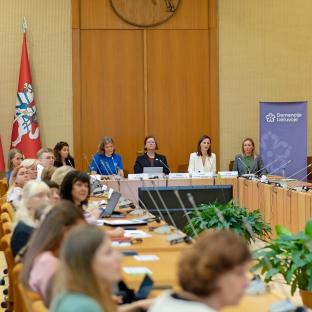
A roundtable discussion “Dementia - nobody's question: is it time for a national dementia strategy?” was organised by the association Dementia Lithuania, at the Seimas of the Republic of Lithuania (Lithuanian Parliament). The patron of the event was Monika Ošmianskienė, a Member of the Seimas of the Republic of Lithuania. The roundtable was attended by guardians and representatives of persons living with dementia, members of the Seimas, representatives of ministries, the academic community and the providers of social and health services. The purpose of the event was to discuss dementia management in Lithuania, the current situation and the direction in which Lithuania needs to go regarding the formation of dementia policy and practice, in order to manage the challenges posed by a rapidly-ageing society.
The vision of the association Dementia Lithuania is one where citizens of Lithuania are protected from dementia and those who have dementia are supported and valued. "In order to achieve this, we must first see things as they are, remove prejudices, dysfunctional systems," said event organiser Ieva Petkutė, head of Dementia Lithuania. She also noted that there are a lot of "invisible" components in the topic of dementia, such as the actual number of people living with dementia, dementia mortality, the cost of the informal care, etc. Jolita Švatienė, who shared her personal story of coming back to Lithuania after 12 years spent in Norway to take care of her mother, offered a space to explore a complexity of challenges that have to be taken into account, when creating the supportive and person-centred systems: the questions of social security, employment, women's rights and the need to support families are just a few. Ministries acknowledged that close collaboration in dementia management is critical, but that the process is complex.
The patron of the event Monika Ošmianskienė, noted that part of the challenges are related to organised efforts to encourage society to see that dementia is an important issue for all citizens: "We have to educate the public not only about ways to protect ourselves, but also to be less stigmatised - to involve the people around us and our loved ones to learn about dementia in order to contribute to the creation of an inclusive society." The event was part of the project "Towards a Dementia Strategy: Situation Analysis and Public Awareness“ which benefits from a grant under The Active Citizens Fund from Iceland, Liechtenstein and Norway, through the EEA Grants. Sonata Mačiulskytė, Chairperson of European Dementia Carers Working Group, took part in this discussion. You can read her perspective in our "Living with dementia" news section.