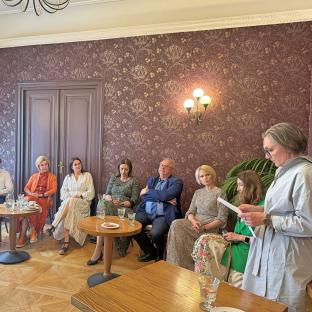
NGO Living with Dementia held an "Experience Café" on 22 May in Tallinn with the candidates of the political parties in the European Parliament elections. The Experience Café is a meeting place for the members of the NGO, people with dementia, their relatives, specialists in the field and other interested parties. At the event, the joint discussions revolved around how to ensure the dignity of people with dementia and what the legal system can do to protect the rights of people with dementia both in Europe and in Estonia. Seven European Parliament candidates from seven different political parties took part in the discussion: "Is it only in their own interest to represent people with dementia?". The discussion was chaired by Sirli Peepson, a member of NGO Living with Dementia. As an introduction, Chris Ellermaa (pictured, right), member of the European Dementia Carers Working Group and Board member of NGO Living with Dementia in Estonia, opened with the scope of the dementia topic in Europe and Estonia:
• By 2025, there will be 9.1 million people living with dementia in Europe.
• By 2050, this number is estimated to reach 14.3 million.
• According to the World Health Organization (WHO), it is the third leading cause of death in Europe and the seventh in the world.
• According to the WHO, the cost of dementia in Europe in 2019 was 392 billion euros.
• An estimated 23,000 people with dementia lived in Estonia in 2019, which is 1.74 percent of the Estonian population.
• By the year 2050, the number of people with dementia in Estonia will increase to an estimated 35,394 people.
All the candidates who participated in the discussion agreed on the importance, scale and number of dementia diagnoses and related issues that need to be addressed. By the introductory part of the discussion it became clear that everyone in the hall had their own personal experience and story with dementia. Participants emphasised that in the case of dementia, not only the people living with dementia need support, but also their families and loved ones. The role of the patient advocacy organisation cannot be underestimated and is very important so that people are not left alone. It was brought up many times during the discussion that dementia is also a big financial cost for society and for the family. Despite the fact that awareness of dementia is growing, the topic should be dealt with more systematically. According to the UN Convention on Persons with Disabilities, countries have an obligation to deal with this topic on the one hand, but also there is a great need among all kinds of "invisible disabilities". From the country's point of view, there is a need to find bottlenecks and specific laws needed to be changed. At the same time, some important actions have already been taken, like the amendment to the law concerning long-term incapacity for work. The amendment also applies to dementia, in that the employer can keep a person working part-time.
During the discussion it was agreed that the day-care centres are the minimum level that municipalities can manage relatively easily. The day-care centres should exist as a structure and if those can keep the loved ones going to work, the personal income tax back will be paid back to the state budget. "A person with dementia is a normal person who just needs to be observed and interacted with. It is possible to make life with dementia dignified for both carers and people, so that they are not socially isolated. At the same time, the availability of social services varies greatly across Estonia, and there is still a long way to go before harmonisation", says Chris Ellermaa. The participants unanimously agreed that legal issues must also be dealt with in relation to dementia: how to ensure that there are intermediate stages before the loss of legal capacity, when a person can participate in decision-making with the help of a representative of their choice. Dementia is a long-term and slow-moving disease, and supported decision-making, step-by-step representation, is an important issue for all loved ones in this area. Social welfare and medicine are not organised at the EU level, it is up to each Member State. The use of public sector money could be more effective if we knew more about this disease, said Chris Ellermaa. As a final comment, one candidate stated that guardianship for people living with the dementia must be "dignified and European".