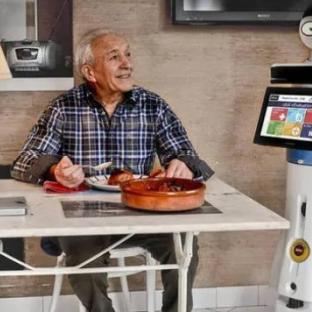
A conference on “Technologies and the surrounding environment in supporting daily coping of people with dementia” was held in Estonia on 25 May, aiming to offer solutions for how people who need care could lead an independent and active life for as long as possible. Independent life is what helps to delay the symptoms of dementia. Technology forms a part of our lives, also when it comes to dementia and care. The conference focused on answering the questions of whether and how technologies can help families, whether technology could “replace” a human being, or if it should do it at all. The opening speaker of the conference was Hunn Wai – a designer and co-founder of the design company Hack Care from Singapore – who gave tips on how to create a home that would not confuse people with dementia, be comfortable and assist with activities. The Singaporean design studio’s speciality is dementia-friendly furniture, tableware, etc. Up next, Dympna Casey from the National University of Ireland, Galway (NUI Galway) explored questions around who social robots are developed for. Can a robot take the place of a carer? What is the role of robots and where should they be used? The Head of Koeru Care Home, Terje Teder introduced the first-ever social robot in Estonia, Paro the harp seal, being used at a care home. The therapeutic robot responds to voice, touch, temperature and communicates by making a sound. The presenter also noted that smart assistance in care can also come in the form of smaller, simpler and inexpensive solutions, such as guideposts and signs, as well as simple movement-activated light solutions, all of which are readily available.Activity Therapist and PhD student Aisling Flynn, from Ireland, introduced memory technology research rooms, one of which she works in herself. In addition to introducing assistive technologies in these places, free assessment and counselling are also provided. An activity therapist decides, based on each client's individual characteristics, which technological assistive tools and minor modifications might be of help to that particular person. Clients are also referred on, or receive follow-up assessments, if needed.Kimberley Littlemore is a documentary maker from the United Kingdom. She shared her very personal experience with delegates: She filmed her parents, who live with dementia, to show what domestic life looks like through their eyes. Her parents agreed to make this film because they want to help people to understand how people with dementia live and to grasp what kind of challenges they face on a daily basis.Following this, Viktor Saaremets, Head of the Prevention Department at the Estonian Rescue Board, shared some experiences of accidents in the home, showing that people living with dementia are also at risk in their own homes and highlighting how, with a little help from the technological tools available, a home can be made a safer place. Families and carers of people with dementia buy smartphones to use with monitoring devices and keep an eye on people with memory impairment who might become lost. Ene Jõeveer, a family member of a person with dementia, shared her user experience. Urban space sets some limits to the use of GPS devices as they might lose the signal on public transport or in staircases; the accuracy of location becomes critical in a tight network of streets.A city is age-friendly if the entire community contributes to considering the needs of the elderly. The city of Tartu is set to become age-friendly by 2030. Mihkel Lees, the Deputy Mayor of Tartu, stated that all people of Tartu should be able to lead a long, independent and full life in their hometown and noted that local government should think about preventing a need for assistance from early on. A well-designed public space contributes to that, he stressed.The moderator, Tiina Tambaum said that people with dementia want to carry on with their normal day-to-day lives and that, despite remembering things from their childhood more clearly, as the disease progresses, this does not mean they become children. People with dementia want to engage in meaningful activities, no different from anyone else. None of their needs disappear. They want to hear their names spoken, feel touches. The settings – rooms and people – must create an opportunity to use what the brain still has left. Technologies can help but will never replace care provided by another person, she concluded.A short film about dementia was presented at the conference. It can be watched, here (with English subtitles): https://vimeo.com/568427982 The full conference report is available, here (in Estonian): Tehnoloogia on hea, aga ei asenda inimest | Elu Dementsusega