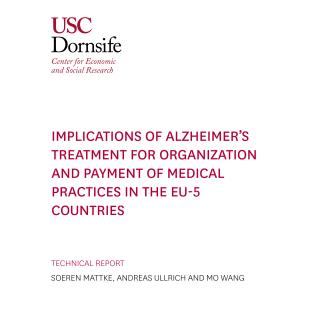
During the Alzheimer’s Association International Conference (AAIC), researchers from the University of Southern California (USC) shared findings from their research examining the medical treatment and costs associated with treating Alzheimer’s disease. Soeren Mattke, Andreas Ullrich and Mo Wang of the Center for Economic and Social Research (CESR) at the USC Dornsife College of Letters, Arts and Sciences, assessed the hurdles to providing treatments to people with Alzheimer’s in the United States, as well as in France, Germany, Italy, Spain and the United Kingdom.
Split into two reports (one for the USA and one for Europe), the research considers what healthcare systems could do to prepare for the introduction of a novel disease modifying treatment. In addition, the reports detail the stages of a person with Alzheimer’s disease from the point of diagnosis, assessing the system-wide obstacles to the introduction of a disease-modifying treatment and how these challenges might be overcome.
The report for Europe highlights a number of encouraging examples of existing practice, including:
-
A national network of memory clinics for routine care and research in France
-
Annual comprehensive geriatric assessment including memory complaints in Germany
-
A national expert group and dementia observatory to track progress and data in Italy
-
A Centres of Excellence based approach to memory care in Spain
-
Co-location of memory services in acute care hospitals for access to procedural skills and infrastructure in the UK.
However, it also identifies the need for countries to devote additional resources to memory care, engage primary care physicians in case-finding and triage, and make use of clinical specialists’ time more effectively. Other challenges identified across the six countries include:
-
Dementia strategies produced by countries tend to be unfunded
-
Countries having limited capacity to conduct PET scans to diagnose Alzheimer’s disease
-
Where capacity does exist in healthcare systems, there are few incentives to make use of it
-
The capabilities to deliver high-quality memory care are limited, mainly related to issues around workforce.
The report for the report examining the USA can be found at: https://cesr.usc.edu/sites/default/files/ADUS.pdf
The report for the report examining the EU5 countries can be found at: https://cesr.usc.edu/sites/default/files/ADEU.pdf
The research was funded by a contract from Roche, known as Genentech in the United States, a company that is developing blood-based assays and disease-modifying treatments for Alzheimer’s disease, to the University of Southern California. The sponsor had no role in the design of the study, interpretation of the findings and decision to submit the data for presentation at AAIC.