"Networking care practice and science in the care of people with dementia in long-term care through the 'Dementia Living Lab Approach' together with people with dementia"
Participation of people with dementia in research was the exception rather than the rule in Germany, until a few years ago. Arguments such as that we, the people with dementia, are not able to give appropriate consent to participate in research studies, that our ability to understand the implications of the study and make informed decisions is not sufficient, that we cannot provide accurate and reliable information or that the emotional burden is too high, are outdated. Countries like Scotland and the rest of the UK, that involve people with dementia in research, demonstrate this clearly. I am very glad that, in recent years, there have been increased efforts to promote the participation of people with dementia in research also in Germany. Finally, guidelines and assistance modules have been developed to ensure ethical standards.
The "PraWiDem" project is a wonderful example of this. And for me it is great, to be an active participant in this project. My name is Lieselotte Klotz. I was diagnosed with dementia at the end of 2017, which tore me out of my active and successful private and professional life and, since mid-2021, I have been a voluntary member of the "Living with Dementia" advisory board, the Dementia and Research Working Group of the German Alzheimer Association and of the European Working Group of People with Dementia (EWGPWD) at Alzheimer Europe. In Germany, we have had a national dementia strategy since 2020. One aspect of this strategy is that research into the care of people with dementia must be strengthened and improved. The specific project as part of this endeavour is "PraWiDem".
PraWiDem is taking a new path. Science and practice support each other in order to find answers to current questions. This is to take place through a constant lively exchange (Living Lab). Based on the experiences of "The Living Lab in Ageing & Long-Term Care" in Maastricht, important topics such as improving the quality of life of people with dementia in need of care, improving the quality of care in Germany and supporting the working conditions of employees in long-term care are now also to be evaluated and improved in Germany.
The approach is linked to Field of Action 4, of the National Dementia Strategy, which deals with the development, implementation and evaluation of new care concepts. Cooperating partners are: Heinrich Heine University Düsseldorf, Medical Faculty of Martin Luther University Halle-Wittenberg, University of Cologne, German Alzheimer Society e.V. (DAlzG). The very special thing about "PraWiDem" is, that a dementia and research working group was founded right from the start, in 2022. Four people with dementia are now accompanying the project and will be a relevant pillar of the research team till 2024. I am not the only one who is more than enthusiastic about the approach of developing, implementing and evaluating new care concepts that directly take into account the perspective of people with dementia and their relatives. All four of us think it's great and are highly motivated. We are consulted and can contribute our knowledge, our positive and negative experiences from our own lives and experiences as those affected and also as relatives.
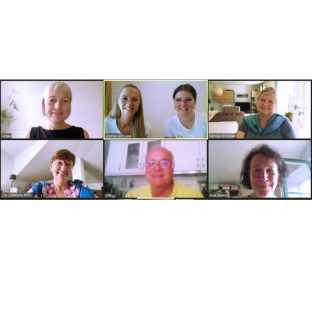
The atmosphere in our team is wonderfully benevolent, respectful and appreciative. We are very creative and everyone likes that. Specific situations and questions from one of the practice locations are outlined and then we work on the questions arising in 60-90-minute Zoom meetings. Together with the researchers and practitioners, we talk openly and honestly about the respective perspectives, concerns, needs and wishes of people with dementia and their relatives and carers. We: Simone, Pieter, Roland and I, supported by Helga (DAlzG) started with a frequency of meeting every two months, and now we meet most months, for a Zoom meeting (at our own request). We can actively do something to improve care in Germany. That is highly motivating. Our common motto is: To keep going and always try to do our best in every situation and get involved. "NOT WITHOUT US!" is our demand to research, politics and our environment.