Once you have passed your driving test, an earned privilege, the law assumes you are able to drive unless you are disqualified for some traffic offences, or are judged no longer able to drive safely, due to certain illnesses, dementia being one. Note: Motorbikes/scooters are included as you are a road user and could still be involved in an accident, or cause an accident, resulting in someone’s injury or death, including your own, or worse, your grandchildren and other loved ones. Car drivers graduating to driving a lorry/bus/fire engine or other heavy road vehicles, must pass a further test.
In my case I did have driving problems, among other difficulties, such as attempting to drive down the wrong side of a dual carriageway several times. I was positioned to turn right, indicating, ready to proceed, and it was only due to oncoming drivers flashing their headlights at me, that I was prevented from making that potentially fatal manoeuvre. Had they not come along at that time, I would have been off down the wrong side. I couldn’t understand, where I had gone wrong.
When the average person hits problems, they devise ways to get around them. I was no different.
I was also having trouble at roundabouts. When I approached and read the directions, I would forget in an instant, where I had to go. I used to circle several times, feeling more and more dizzy and still take the wrong exit in panic. I began to take the first left and, if it was not the correct road, I would do a U turn and return to the roundabout, then take the next left and repeat the process, until I reached the exit I wanted. It was a laborious but safe way, of getting through roundabouts. This worked well until one day I turned left, and came to another roundabout. After that, I steered clear of strange roundabouts, and stuck to local routes.
My wife Maureen refused to sit in the car with me, if I was driving. Whereas before, she felt perfectly secure about my driving abilities, as I was a safe driver and had never been involved in an accident, she was now uneasy and concerned. She stopped me taking my young son out with me in the car, as she was frightened for him. She remarked that when say, going along a motorway, I kept weaving from one side of the lane to the other side then back again. I couldn’t seem to hold a straight line. This of course I strenuously denied. I was a perfect driver. Looking back, it is clear I had a condition called anosognosia, the denial or unawareness of an impairment/disability.
I also started stalling the car, a thing I had never done since my early “L” plate days. My clutch control was haywire. I blamed the clutch and had it replaced. But I still stalled the car and grumbled that the garage had done a poor job. I hit kerbs (curbs) when turning corners, and I just couldn’t fathom out, what on earth was going on. Having been a keen cyclist, I knew how to turn a corner and I never hit a corner when I held a provisional licence. I did report my driving problems to my doctor, who advised me, to stick to roads I knew very well.
It all became clear when I was diagnosed with dementia. You have a duty to report a medical condition, which might affect your driving ability to the DVLA (the regulating body in the UK for drivers), otherwise you are in breach of the conditions of your licence. Write to The Driver’s Medical Group, DVLA, Swansea, SA99 1DL. Phone- 0870 600 0301. Fax- 0845 850 0095 Web Site www.gov.uk/dementia-and-driving Other countries will have their own rules and regulations.
You should also let your insurance company know because, if you are in an accident, even though you are blameless, they could deny responsibility and you are left uninsured, facing huge legal and repair costs on your own, which could bankrupt you.
It is not worth the risk of taking a chance and keeping mum. A judge can apply to see your medical records. I thought my medical records were private, obviously not. My psychiatrist advised me to stop driving. But after coming to terms with my illness and receiving medication, I felt capable of driving, now that I knew what was wrong. I felt ever so much better and more aware of my surroundings. So, I persisted with applying to continue to drive. I sat a test arranged by the DVLA and passed it. I was given a licence to drive for three years and continued to drive cars and vans. I had no further problems and felt I was driving safely in my comfort zone. I no longer undertook long journeys, as I felt it was not in my, or other road users’, interests, to get overtired. I, like many people with dementia, lose concentration when weary, or as the day goes on.
However, when my time up, and I was accident free, I applied to renew my licence, fully expecting (and rightly so) to sit another test. I heard nothing for six months and on a Christmas Eve, I received a letter from the DVLA saying they were withdrawing my licence. Why couldn’t they have waited another day, especially after keeping me hanging on for six months? What a Christmas spoiler! They did tell me I could appeal to the Courts (twenty-one days in Scotland, six months in England), but warned me it could be costly and may be unnecessary. By this time, my wife was in charge of the finances and refused to give me money for an appeal. She was terrified I would get back on the road. I felt this was against my human rights and I should have been given another test. If I failed, then so be, I was no longer capable of driving safely, and would have accepted it, albeit reluctantly. But I felt aggrieved that I was denied a chance to prove myself. I later found out it was my GP who had provided the report which barred me. Yet the ironic thing is that after diagnosis by a Consultant, my GP had never mentioned the word dementia to me. I only went to the doctor when something was hurting me physically. She had no idea that I had been driving safely, and was unaware of my capabilities. Remember, dementia and driving, were never discussed again. Why should a GP have the final say in extracting your licence? You should show your capability on a driving test.
It is a bitter blow losing your licence and you have no idea just how crippling it is, until it happens to you. Your mobility is turned upside down. Your freedom to get up and go at a moment’s notice is gone. You lose your independence. You may have to rely on others to get about, even where there is public transport. It may turn up only several times a day and stop in the early evening. You may get out but not get home. You feel a nuisance if you ask, and are reluctant to bother busy people. You may feel infantilised, taken about like a toddler. Some places are off bus routes and the beaten track, and you can no longer travel there, unless someone has the time to take you. It can be humiliating and demoralizing. If lucky, you go in their chosen time, which may not coincide with your chosen time. For example, I might want to go for a dawn photograph but the driver is only free in the evening. You are at their mercy. After all these years it still rankles to be a passenger. I still feel I can drive (apart from big roundabouts) and when I sit in a car, I still “drive”. I watch the road, looking out for potholes, cars entering the main road, scanning for pedestrians, especially children and animals. I am always saying (to other’s annoyance) there is someone in the mirror. I am a terrible front seat passenger and get tired on a journey, as I watch the road like a hawk. My feet get sore with driving. Why both feet? The imaginary clutch and brake! I can anticipate other driver’s manoeuvres and know when they are going to turn, when not indicating. I feel I can still drive, just give me a chance.
In conclusion, the medical person who comments on a person’s ability to drive, should be the person who sees and treats the person with dementia, for the dementia.
If someone is not diagnosed until well on into the illness, they may clearly be unfit to drive and may realize it themselves. All others should be allowed to sit a test.
If someone has their licence withdrawn without a test, and they respond to treatment and medication, they should be allowed to sit a test, and abide by the result.
I also strongly feel that in appropriate cases, there should be a restricted licence available.
For example, you could be restricted to say, daylight only, A or B roads, not motorways, your local town, X miles from your home, or so many hours a day. If you live in a rural area or on an island, where the traffic is light, and there are no confusing roundabouts and the bus service is poor or non- existent, and you are tested and pass, you should be able to be allowed that restricted licence. You should of course be able to pass further tests. But you must abide by the restrictions and not be tempted to drive say, into a large city or on a motorway, without facing a penalty, such as the withdrawal of the licence. There may be a special plate made up, say like in “L” and “P” plates, to indicate you are driving on a special licence. But would that draw unwelcome attention from the police and scammers? And would people feel stigmatized or labelled?
I met a few people who wanted to drive after diagnosis, but feared the assessment. Someone who say, lives in the islands or a remote community may never have driven on a motorway/dual carriageway in their lives, and have no intentions of ever doing so. If suitable for an assessment they are called to the only Assessment Centre in Scotland, in Edinburgh. Many complain this is grossly unfair as they have to drive an unfamiliar car and in an unfamiliar area. However apart from the unfamiliar controls on a strange car, a full driving licence (albeit for just a year or two) means they can take off the next day, and go roaring alone down the motorway, and find their way through strange towns and cities such as Manchester, Birmingham and London. And also drive in all sorts of conditions. People may drive safely in their own area, but what happens if there is a long diversion with roundabouts, crossings towns and strange roads? What if they planned to be home by dusk, and the longer route means driving in the dark? Drivers without dementia may baulk at this. Drivers with dementia, may be more susceptible to problems.
Why should a safe driver with dementia in the Highlands and islands, not be allowed to drive locally, where they know the local roads intimately and will never drive on the mainland? I myself have been to Stornoway and saw for myself, the huge distances involved, if you want to nip out for a newspaper, a loaf or a pint of milk. Something many take for granted. It can be so isolating, to be so far from shops and places to go for shopping, worship, library, doctor’s premises and company.
Note. While most things did happen to me, I am aware now of other problems, some may experience when driving, viz:
- Hitting the gate post when entering a drive.
- Hitting the kerb when parking or turning corners.
- Being involved in “near misses”. Someone else’s quick reactions prevented a bump.
- Being involved in low speed crashes, or worse, high speed collisions, or causing them to happen to another driver, then driving away safely, unaware of the carnage they caused behind them.
- Getting tickets for traffic offences e.g. bad parking: parking on double yellow lines, on corners, at fire hydrants, speeding in safety zones, such as outside schools/hospitals and jumping red lights etc.
- Other drivers blasting their horns at you for some traffic violation, or gesticulating at you.
- Minor bumps/dents /scrapes on the car body and/or the tyres, alloy wheels or wheel trims/ hubcaps.
- Getting lost while driving, and having to stop to work out where you are, and if coming or going. This may mean you return earlier than expected from a trip, or later.
- Having problems when turning at junctions across the stream of the traffic coming towards you. Right in countries where you drive on the left and left in the countries where you drive on the right. This is where junctions may or may not, have traffic lights and filter lights.
- Misjudging the speed of other traffic, when joining major roads from side roads, and when changing lanes, on dual carriageways and motorways. Weaving within your own lane. Ignoring your mirrors. Forgetting the mantra, mirror, signal, manoeuvre.
- Taking longer on routine, regular, journeys. Where did the time go?
- Going at an inappropriate speed e.g. too slow for the type of road you are on, or going above the speed limit for that road.
- Forgetting where they parked the car, or going home by some other means, such as bus/train/taxi or lift from a friend they met, forgetting that they came by car.
- Not slowing for pedestrians, who have the right of way and who may have to jump for their lives.
- Going the wrong way down a one-way street/ dual carriageway/roundabout.
- Unaware of running red lights/pedestrian crossings/traffic signs or other barriers such as for trains at level crossings and river crossings for boats on canals.
- Trouble trying to fit within parking lines/bays, especially when reversing.
- Problems with driving in the dark, exacerbated when it is raining/snowing. Note, a sight test may show the eyes are in order, or ok with glasses, but there may be a problem between what the eyes see and what the brain processes. There can be a communication blindness.
- Passengers squirming, sweating, dismayed, telling you to be more careful as you have just done something dangerous, and were lucky to avoid a collision with someone or something. Passengers expressing disquiet at your driving etc. People refusing to sit with you, when you are driving, or your children refusing to let your grandchildren sit in the car, when you are at the wheel.
- Driving home and forgetting to pick up their spouse/partner from work or the kids from school.
- Road rage and swearing at other drivers (who may be innocent, it was you who caused the problem) from a normally placid person.
- Muttering how bad/selfish/intolerant, other drivers seem to be these days.
- Getting angry, irate, confused and bewildered.
- Jay walkers causing them a problem, but are they jay walking? Are they taking off too soon?
- There may be a connection to tachypsychia. When a situation arises, the person may freeze in fear or fright. Time passes in slow motion as they frantically try to get out of it. There may be dilated pupils leading to loss of peripheral vision.
- Inside the car. Forgetting to look in the mirror, signal, dip headlights, monitor the fuel gauge, water temperature, oil pressure and watch the speed, according to the local regulations. Forgetting to wear their seat belt or ensure passengers use theirs.
- Alexia. This is a problem with reading and explains why I had major trouble reading destinations at roundabouts.
- Outside the car. Forgetting to check the engine oil, tyre pressures, washer bottle, brake fluid level, weekly check on car lights and fuel gauge. Do they run out of fuel at times or put in diesel/derv instead of petrol and vice versa? Are the mirrors inside and out, properly aligned?
Finally, do not expect someone to surrender their car keys without a fierce fight. If they do hand them over, feel lucky. They may be aghast at any suggestion to stop driving. It can be like a death knell. There may be bitter recriminations, making you feel guilty, about what you are doing to them. The car may be an extension of their being. They sacrificed to bring you up! They were doting parents! They have been a lifetime, loving partner! They always put you first! How could you be so cruel and unfeeling? You may be sent to Coventry. It really is best to give up your licence voluntarily, rather than suffer with rage, anger, bitterness and vengeance, at having it wrenched from you.
But remember, you have a duty of care towards them, as you would a child growing up. It is heart-breaking making the right decision. You are tearing out their heart and demoralizing them, but you will have them for longer, without the added worry of what grief/havoc they could cause in your or someone else’s life. Plenty of TLC comes in handy. Understand their anguish and possible anger towards you. You are surgically removing a great part of their life. It will be a knock to their self-esteem, a blow to their confidence, giving them a sense of failure. Yet they did nothing wrong. There can be an overwhelming sense of loss. They may say “what have I done to deserve this!” They may “blame” you. This is where counselling could hopefully help them cope. But it may not work for all. The last cut is the deepest. You can only do your best, you are only human.
Some people may have cognitive problems but will not seek help from their doctor. Yet it may be some other illness or MCI (Mild Cognitive Problems) and they could continue to drive. Some could have the type known as PCA and be quite alert mentally but experience eyesight problems, such as a loose connection between the eyes and the brain. Some people may be in the early stages but have co-morbidity problems which can badly affect eyesight, such as diabetes. As I said, if living in an isolated area, they may be frightened to ask their doctor in case they lose their licence, and cannot get to work, go shopping, visit their place of worship, visit aged parents/relatives and take them a wee run or take their grandchildren, spouse/partner out, or keep up their pastimes/hobbies.
It is better to persuade them to cease driving out of love and concern for them and others, rather than have some official body wrenching your licence from you. After fifteen years, I am still resentful! I would love to drive again even if it was on a race track while not in use, field, forest road or a (deserted) sand/shingle beach. You could use a beach buggy or a quad bike (helmeted of course). I have actually done this on a beach and on a supervised quad bike course. I have never tried a jet ski on snow and water and wonder if this would satisfy my yearning to control an engine again, and feel the thrust at my fingertips. One thing I will try some day, is the dodgems at a fairground. But where are fairgrounds these days?
I have never seen a simulator, but I wonder if using one and getting the feeling of being on the road again and manipulating the controls, would give me release from my torment at not driving.
Research what is available, to get them out of the house, to carry on life as before. Family, neighbours, friends and members of clubs may be able to offer lifts. Is there any other alternative to driving? I must admit I do not sit back and watch the scenery. I watch the road like a hawk and test my wife’s patience when I say things like “you went too slow there”, “you could have passed” or “brake!” I am forever threatened with having to walk home, if I don’t stay quiet.
There may be free or cheap fares on public transport. Taxis in some areas offer discounted travel to people with disabilities. It could be healthy and stimulating to walk to the local shops for light shopping e.g. a newspaper. You could chat to friends, you may meet on the way.
If someone is having driving problems and have not been diagnosed with dementia, remember other illnesses can mimic dementia. Get a proper assessment as soon as possible.
Finally, if someone is clearly unfit to drive, they must get off the roads. No ifs, buts or maybes.
It may be useful for all adult children of elderly parents who are still driving, to go for a run with them from time to time, to see for themselves, if they are still driving safely.
I know that four years ago, I realized I could not drive, as when I sat in the front passenger seat, I could no longer “read” the road or follow the signs. My sense of anticipation, so necessary these days, was gone. Too much information confused me. Even as a passenger, I hate dark wet nights.
After twelve years off the road, I have never lost my desire to drive again and when out in the car with my wife, I always moan I should be driving again. I couldn’t even bear to sit behind the wheel.
My wife was off to my son’s wedding in Australia (which I was too ill to attend) and left the car keys. I did sit behind the wheel (a first for countless years) to start the engine and charge the battery, as she was away for three weeks. I felt so at home, I was severely tempted to go for a drive. Memories came flooding back. I felt like a young man again. I argued with myself and eventually turned off the ignition, and went indoors. But it was a near thing. She will have to hide the car keys from me, lest I give way.
Ten years to the month I last drove, I was on holiday in a wee bothy by the sea. It was right on the water and reached by a private road. My wife let me behind the wheel and I took off, no stalling and changed gear smoothly to second gear. It was fantastic and I had no trouble at all. I drove a few hundred yards in a straight line. My driving abilities were not tested in this brief journey. Next day I took quite ill-jaundice and was unable to try driving drive any more, ending up in hospital.
Mind you had I been allowed on the highway, would I have coped with streams of traffic, traffic lights, roundabouts, right turns, lorries, buses, cyclists and pedestrians? We will never know!
If it is useful, see my article on Early Diagnosis.
Professionals who may see this article. The UK Dept for Transport have issued a paper “Attitudes Of Health Professionals To Giving Advice On Fitness To Drive (Report no 91) 2010”. This contains a lot of detail for you.
Driving again after twelve and a half years
When I developed multi infarct dementia I sat a test and was given a limited licence for three years.
When it came up for renewal, my application was refused by the DVLA when they wrote to my GP. I could have appealed, six months in England and twenty-one days in Scotland. My wife, now in charge of finances, refused to give me the money for an appeal, as she was terrified of my driving abilities. Inter alia, I almost went down the wrong side of a dual carriageway several times.
But I have never lost my desire to drive again. When out in the car with my wife driving and seeing horrific manoeuvres by other drivers, I drove her crazy by saying I should be driving again. I felt I could drive again and nothing could dissuade me. She reminded me, I was off the road for life.
Anyway, to cut a long story short, I casually mentioned this to the staff at Dementia Adventure who take people, who may never have been out of the house or care home for years, on an adventure, they have longed for, for years. More details at www.dementiaadventure.co.uk (01245 237 548).
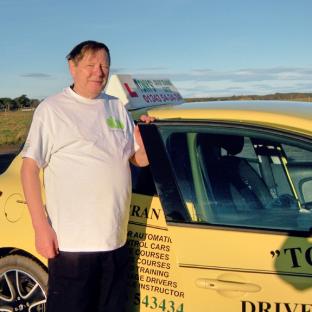
Unbeknown to me, they made plans to make my dream come true. When I was staying at Newbold House, Dementia Adventure told me they had arranged for me to go two hours driving on an old airfield. They got in touch with a driving school, Tony’s in Elgin, Morayshire, and a driving instructor, who would take me driving in a dual pedal/control car.
How Tony’s agreed to that I will never know. I am seventy-four years old, have dementia and have not driven for twelve and a half years.
I wanted it to be like a driving test, so that I could handle the car like I used to do. I settled in and took off, no stalling or juddering. The instructor told me when to change to second gear and never advised me again. I went through the gears until I was doing sixty MPH. I could still hear the engine and knew when to change gear. There was a right-angled corner on a curve and I slowed down by easing off the accelerator and changing down gears, then when straight, speeding up again.
I did three-point turns, reversing around a corner, reversing between two cones from both directions, and changing up and down the gears. I watched my mirrors and indicated when coming to a stop or when turning. I WAS IN CONTROL AGAIN! My foot was on the accelerator.
The instructor did not need to intervene or change his career after the event. Elgin people could breathe again.
I was disappointed I could not do a hill start (airfield), but felt I could have managed one.
The airfield was owned by Bill, www.skidcarscotland.co.uk Ltd, Moray Academy of Transport and Training, who also had an area for training lorry drivers and a skid pan. He took a keen interest in what was happening, came over and generously said I could have a try on the skid pan. He also said I was welcome back at any time, even on his day off. Thanks, so much Bill, you are a gentleman.
However, after two hours’ concentration, I felt mentally unable to handle any more and, as I knew I would never be on a public highway again, I politely declined. One good thing about dementia is that you get to meet a lot of lovely people who go out of their way to help you. Bless them all! It took days to calm down after the event, I was on a high. I would never in my wildest dreams have imagined I would ever be behind the wheel of a car again. Afterwards, my wife and DA members went to see Victoria at The Loft, Kinloss, Forres, www.eastgrange.co.uk for a cappuccino, to relax and chat about mutual interest, in people with dementia having a life.
Thank you so much to all the staff at Dementia Adventure, including the behind the scene backroom men and women, who made this dream come true and Tony at the driving school.
Now what will the medical profession make of this? Am I unique, a one off? I certainly think not. Dementia Adventure took people who previously sailed, out on a boat, going against those who said it was no longer possible. Within a day they were competent enough to take charge while the crew had a cup of tea. I can see research coming out of these two events, a new life for people with dementia until the illness takes over, as it wins in the end. But you don’t have to live a life of misery until that happens. You can live life again! Going out enjoying yourself!
Why was I able to drive again? Is it a skill you never really lose, like riding a bike? Why are people able to do things, that professionals have declared impossible?
Perhaps Neil Mapes, director and founder of Dementia Adventure (DA) will be able to answer that question, as he and his innovative staff, take more people on more dementia adventures.
There are too many people (whoever they are) stopping you from enjoying your hobbies with a trained supporter. Naturally there are some things, such as flying a passenger plane, which are just not possible, but always consider alternatives. They could take the pilot up in a glider with an instructor in the seat behind, who would keep them safe. If they have the funds they could sit in a flight simulator and enjoy “flying” again. With the right mindset you can make things happen.
I would like others to emulate me and have that feeling of satisfaction, when they succeed.
Caution. I am under no illusions that I could ever drive on the public highway again. I can handle the mechanics of a car, as I have proved, but as I can only cope with one or two items at a time, I could not handle the complexities of driving while having to cope with bad drivers, pedestrians, cyclists, other road users and confusing town signs I simply can’t take it all in. When sitting in a car with my wife driving, I get anxious at roundabouts. If we go through too many, such as at Braehead shopping centre, I scream “get me out of here!” I get really agitated. In bed last night, I came up with the idea I should close my eyes and block out the roads. When people with dementia get overloaded they shut down. I cannot drive safely on the road, ever. Period!
I would not want others who I hope will share my experience, to think they are fit to be on the road. Be content, as I am, to have the satisfaction of knowing “I can do it”. I feel I could die happy now.
Were there side effects from my exhilarating experience? Yes, there were; good ones.
When I got home, I found I could walk faster, as for some time I have been walking slowly, head bent. I found that I was able to recall facts from fifty years ago, things I had completely forgotten about. I was able to help more about the house, taking a little of the burden off my wife. I was able to write this article by myself. My short-term memory, notoriously bad, improved slightly. My sense of wellbeing was high. It will be interesting to see how long this feeling of euphoria lasts. My wife will no longer be tormented by me saying “I could drive again”, when out driving with her on trips. She gained some respite now and will in the future (but it was not the intention), from my experience. My troubled soul is fulfilled now. I will be less of an albatross round her neck. Unfortunately, dementia can dull your feelings. And this happened to me. I found that after the event, I have become more affectionate towards my wife, giving her the odd cuddle and being more considerate.
People with dementia need a good sense of humour to survive. Six days after leaving Newbold House, I went with my wife to a social evening with her church group. I was able to contribute to the gaiety with jokes that raised a laugh. I was part of the gathering. I am still on a high from my experience.
I had such a great time I can’t get a tune from Dirty Dancing (a favourite film) out of my head. It keeps coursing through my veins. It is “(I’ve had) The Time Of My Life” by Bill Medley and Jennifer Warnes. I really did!
Will I drive again? I think not. I do not feel I need to drive again. I have proved I can still control a car in safe conditions. My beliefs have been vindicated and I can rest contented. I was out a run today with my wife. I never once complained I should be driving again. Oh, blessed peace for her.
On to pastures new, another of my mantras; people with dementia can be creative!
DA don’t start off with saying something can’t be done. Their first thought is, how can it be done? Of course, sometimes they consider something too dangerous and rightly cannot go ahead, but is there an acceptable alternative?
Apart from a car/lorry driving licence some occupations also require a licence/certificate. Such as driving a train, the master of a ship, the captain of a plane/hovercraft/balloon and the commander of a submarine etc. These people may get regular, rigorous health checks.
Some hazardous pursuits may not require a driving licence such as a speedboat racing near swimmers, off road quad bikes, horse racing, drag racing, securing people in zip slides, descending tall buildings/abseiling, high bridges, bungee jumping, scuba diving, and sky diving, to name a few. Some hobbies will rightly need some sort of qualification, to keep you from harm or death. Or from maybe causing someone else’s accident. You may need special insurance.
Some jobs are inherently dangerous, and you may be able to drive to your place of work, or the site where you are working, and have been for some time. Working with complicated farm machinery is one. Sadly, I hear of deaths on farms.
As a former long-distance cyclist, I was advised not to cycle in busy areas such as traffic lights, roundabouts and junctions. A mistake could be fatal. I cannot process the ever-changing situation, to keep myself safe.
The Covid-19 situation brought unique restrictions to the world. Many people, with or without dementia, ceased to drive for long periods. I would advise that all drivers, including those who are a bit nervous, take someone in the car with them, when they go out again on the roads. People can be rusty, and may need time to adjust to the new situation. So do the other drivers on the road. Some drivers flock out at Easter, not having driven, say for the winter. Go easy. This list is not exhaustive, so be alert, and don’t get too tired to think straight.
Dr James McKillop, DUniv., MBE