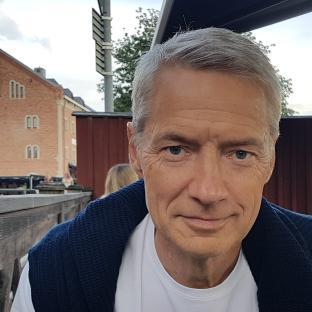
Since I got my diagnosis, three years ago, I have started to write about my daily situation as a form of therapy and it somehow helps me sort feelings and thoughts that come and go with my new life. I have noticed that I am really fond of my new hobby and it has also resulted in a "job" as a columnist in the Swedish "Demens magazin" that is issued four times a year. Here is a shorter and slightly modified version of a column that was issued a year ago in that magazine:
Late one evening I am standing in the shower, letting the warm rays wash over me and calm me down in a meditative way. I, who always have been good at orienteering, had just come back from a training in the forest where I had got lost and almost panicked. Immediately the thoughts had appeared…the doctor's words at the cognitive clinic a few months ago.
"Kjell, you have amyloid clumps in your brain and in the stage where you are right now, we call it cognitive impairment, and yes, it is Alzheimer’s, and you will gradually be getting worse…”. While the warm rays wash over me, "he" suddenly appears again. It´s Tomás, my new friend. I don't really know who he is, or where he's coming from, but he has popped up every now and then since I was diagnosed. He is currently halfway up the left side of the shower cubicle, but he is not visible, he just “is” there. He has no body and speaks only Spanish. "Mi hermano gemelo" (My twin brother) as he calls himself. I don't know why, but I feel safe with him. He gives me an outside perspective and he is also very different from me in his manner, much more spontaneous and does not take life so seriously..."don't worry", he normally says. "Kjell, see the diagnosis as a second chance, an adventure, life isn’t over yet!”. After the shower, Tomás and I start sketching on a sheet of paper, the pieces of my new puzzle, my new life. He asks questions and I try to answer as well as I can.
Sometimes he gets a little too pushy and I must ask him to calm down a bit, after all it's my life we're talking about. What I take with me, though, from what he says, is that there are positive things about the diagnosis...yes. I now know that I have a limited time left to live and function normally. This means that I must be clearer about how I want to live my life and with whom. I can't waste time on acquaintances and "friends" who don't bring anything to my life "just because"…. Suddenly, in the mess of all ideas and sketches that we’ve made, I see the missing piece. You know, that redemptive piece that makes several odd pieces of the puzzle come together. With the “missing” piece in place the puzzle suddenly brings colour, shape and meaning to my new life. I turn to Tomás and say: "Tomás! I realise now that I am not a diagnosis, I have a diagnosis and my focus going forward will be, to not let the diagnosis hinder me until it’s due. Tomás, I want to be an adventurer and enjoy life fully!” Tomás looks at me, smiles and says in Spanish: "Adventurers don't get lost, they just discover new sides of life".
