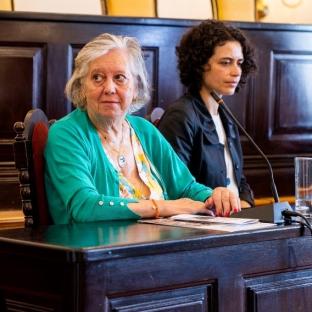
Idalina Aguiar is a Member of the European Working Group of People with Dementia and is supported by her daughter Nélida, to whom we are grateful for her help in translating Idalina's words to English: "Three months have passed...and now, I write these words with the vital help of my daughter, Nélida. On 5 June, my life, which is already very limited, had another setback. The bad fall that my daughter Nélida and I had together, proved to be quite limiting for both of us, though with far more complicated consequences for me: Within one month, I had to be in the operating theatre to undergo four general anaesthetics, due to a prosthesis placement, two dislocation reductions and a new more restrictive prosthesis placement. These were very complicated days in which despair swept through my family, the uncertainty of the success of any intervention, but above all the chance of survival in these cases, for patients with dementia. Weeks of recovery followed, a lot of waiting, a lot of commitment and above all a lot of exhaustion for those who are here, at home, giving me constant care. I often had to use physical restraints, but above all, surveillance became constant. Having Alzheimer's dementia, I do not always remember that I fell (my recent memory is almost non-existent), so it has been necessary to use a physical restraint that consists of a series of techniques whose purpose is to limit my body movement, which are only to be used for my security. Right now, my family has to focus on avoiding any kind of falls.
In these past three months, my life has changed a lot, but I have always stuck to my supplements, medication, and therapies. They had to adapt my room and now at home there is an electric bed and an anti-bedsore mattress with a motor that works 24 hours a day, which helped in my recovery. I started to have social support that is restricted to home support in hygiene care (twice a day). I was bedridden and I went through moments where I didn't even recognise myself and others, and with moments of hallucinations during my hospitalisation. At home, I was recovering with the intense support of my family. I started to have 24-hour follow-up as well. But, I will continue to struggle, despite my limitations, as I still struggle with enormous mobility difficulties. Against most expectations, I started to take steps, with the help of a walker, and we are committed to using a cane for short distances. Once again, I managed to demonstrate that I am a clear example of resilience and I have been a constant fighter and demonstrated that it is possible to live with dementia, despite limitations. I am proud! After just over three months, I returned to my advocacy work, and on 21 September, in celebration of World Alzheimer's Day, I participated in two actions:
Action 1: The Municipality of Funchal (the city where I live, on Madeira island, Portugal) marked World Alzheimer's Day, as a way of showing its support and sensitivity towards people with dementia and their families. I participated in the information action held in the Paços do Concelho building, in partnership with Alzheimer Portugal's Delegation of Madeira. My daughter took the opportunity to emphasise the role of caregivers, who are often forgotten, despite the fact that their role is vital. We remain attentive to inclusion policies, where everyone is important and decisive in the development of mechanisms that can collaborate to improve the quality of life for patients and their families, thus making our society more just and more human.
Action 2: The National Association of Gerontologists called on my experience and availability, and that of my daughter Nélida, to share our perspectives and the challenges of what it means to (co)live with dementia. Gerontologists, professionals, students, and others interested in the subject were able to learn more about what it means to receive a diagnosis of a chronic, irreversible and highly stigmatising condition in today's society. Acceptance, integration, inclusion and empathy were our key words. Despite the inevitable catalogue of weaknesses and difficulties that people with dementia and care partners face on a daily basis, this "Gerochat" essentially served to reflect on the true meaning of person-centred care; on needs, preferences and wishes. We emphasised, also, the importance of taking an optimistic (rather than fatalistic) view, whenever possible. We also highlighted the importance of training of professionals (both in the social and health sectors on dementia and its conditions) and informal caregivers; implementation of specialised and differentiated care, namely non-pharmacological therapies; awareness and demystification around dementia; and last but not least, inclusion, at all times. We are certain that the gerontologists have the necessary skills to respond to all the challenges posed by dementia."