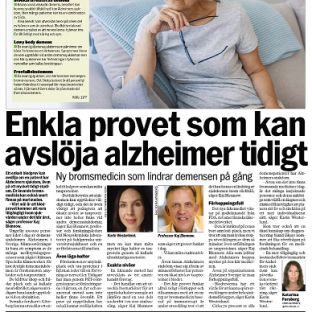
Karin Westerlund of Alzheimer Sweden has been interviewed by Sweden's main evening paper, Aftonbladet. Journalist Katarina Frostensson spoke to Ms Westerlund and to Professor Kaj Blennow, whose scientific research is highlighted in the article. The piece was published on 11 February. This is a rough translation of the article (with thanks to Karin Westerlund): A simple blood test can soon reveal if a person has Alzheimer's disease, even at a very early stage. A promising medicine may also soon be on the market. "We hope that the blood test can be up and running this year", said Professor Kaj Blennow.
Swedish researchers in Gothenburg have, together with an American company, developed a simple blood test that can show even low levels of tau proteins. "This means that the disease can be detected very early, and tau proteins are not found in other dementia diseases, either", said Kaj Blennow, professor and research leader at the Neurochemical Laboratory at Sahlgrenska University Hospital and one of the authors of the study. "It is about developing biomarkers to detect levels that can be compared to a sugar cube in a large swimming pool", he commented. "We can now measure exact levels".
Even before Alzheimer's disease manifests itself in the form of memory loss, the patient has an increased proportion of tau proteins. "This test thus works early in the process and, together with a new type of antidepressant based on immunotherapy being developed, we believe that there may be relief of the disease within reach" stated Prof. Blennow.
The new drug is awaiting from the FDA, the US Food and Drug Administration. "It is mainly focused on amyloid proteins, but we believe that if you succeed in stopping their development, the tau proteins will follow, he said.
Everyone who works with this has high hopes for this medicine. Even at Alzheimer Sverige (Alzheimer Sweden), people are hopeful. "The blood tests are valuable, to be able to track the development during the entire progression of the disease", said Karin Westerlund.
About 70% of all people with dementia have Alzheimer's disease. "Even though there are no disease-modifying treatments today, many people and carers want to get a diagnosis, and to have the opportunity to plan their lives and health in a more individualised way", she stated.
She also believes that increased knowledge about diagnosis among physicians will increase the demand for research for medical treatment. "A more accessible and cost-effective biomarker for Alzheimer's disease can influence Swedish healthcare in the right direction", asserted Ms Westerlund.