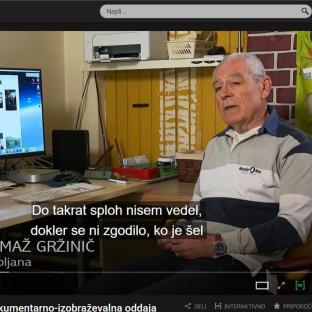
Spominčica - Alzheimer Slovenija was invited to co-create the 30-minute long documentary "Facing Dementia", which aired during prime time on Slovenian national television on 26 January 2022 and which received a lot of positive feedback. Among the participants were Štefanija Lukič Zlobec, President of Spominčica, Milica Gregorič Kramberger, a member of professional committee of Spominčica, and Tomaž Gržinič (pictured), member of the European Working Group of People with Dementia (EWGPWD).
The presenter highlighted that there are more than 32,000 people in Slovenia who have dementia, and that this number is expected to nearly double by 2050. Dementia is one of the most expensive diseases in terms of social and health costs, as well as caregiver burden. That is why Spominčica organises caregiver self-help groups and dementia trainings, as well as raising awareness in local communities by establishing "Dementia Friendly Points", which include hospitals, care homes, ministries, pharmacies, and other locations where people can get information about dementia, and assistance, if needed. Spominčica also runs an SOS telephone line because caregivers and people with dementia sometimes require immediate assistance. During the documentary, Dr Milica G. Kramberger, a neuroscience specialist, noted that dementia is a symptom of neurodegenerative diseases such as Alzheimer's. At first, we can see that a person with dementia begins to forget things and loses orientation, she said.
The disease can be seen in the brain as it progresses. In the Neuroscientific Clinic in Ljubljana, disease is investigated using transplant tests, laboratory blood tests, head imaging, and cerebrospinal fluid examination. Irregularities can appear between 10 and 20 years before the onset of dementia. Štefanija Lukič Zlobec started working as a volunteer at Spominčica when her husband Jaša Zlobec Lukič got diagnosed with dementia at a fairly young age. From the start, she has cared deeply for people with dementia and has tried to connect as many dementia specialists as possible, at an international level. She thus quickly became a very important part of the Spominčica team. In 2014, she became the President of the organisation. She stated in the documentary that, as a carer, you hope for a different diagnosis. Dementia is incurable and can last for a long time. It is difficult for people with dementia because they are losing knowledge as well as memories. She emphasised that, regardless of the disease, people with dementia understand things until the end, even if we believe they don't. It is so difficult to accept that your loved one is changing, she noted.
The documentary also showed how Tomaž Gržinič, a member of the EWGPWD, manages to live alone and how he copes with his condition and manages to live relatively normally. He enjoys riding his bike, cooking, hiking in the Slovenian mountains, tending to his garden, driving a car to his country house and playing tennis every Monday with his friends. The most humourous part of the show was him joking with his tennis teammates about organising a trip. They said that when he organises a trip, they never know where they're going, but that's not a problem because it's a never-ending journey into the unknown, which they enjoy. Tomaž was familiar with dementia because his father had it as well. He stressed the importance of seeing a doctor if you notice signs of dementia. It is possible to slow dementia if you see a doctor as soon as you notice symptoms. He is relieved that his friends have accepted his disease and are not embarrassed by it. He didn't want to stay inside and hide due to his dementia because he believes it would be harmful to him, which is why he is so active in everyday life and regularly visits Spominčica for a chat and laugh.
The documentary also went on to examine the life of a married couple (the husband had dementia and the documentary looked at how he and his wife were still able to spend quality time together), and spoke to Slovenian dementia specialist Jože Škerlj. Because of the stigma, there are too few employees working in the field of dementia, and there are insufficient funds allocated in Slovenia. Because there is no cure for dementia, they must use nonpharmacological approaches and raise awareness about the early warning signs of dementia and how to communicate with people who have dementia. They require calm, routine, predictability, and a sense of belonging. Spominčica's founder, Doc. Kogoj, stated: "The focus should be on the person, not the disease." The documentary is available to watch (in Slovenian), here: https://365.rtvslo.si/arhiv/izzivi-srebrne-generacije/174842465?fbclid=IwAR20Y0NwgS11wfcEGekjzU81DmhZgw9KCbUfHKWAHafr3-FcQ_VJ7g_nkuo