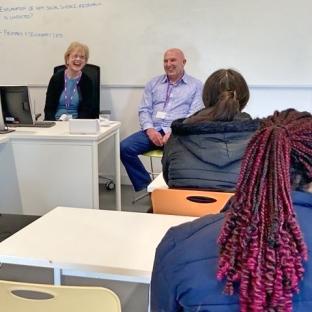
Alzheimer Scotland’s Active Voice groups, the Scottish Dementia Working Group (SDWG) and the National Dementia Carers Action Network (NDCAN), have a shared priority to support workforce knowledge and development, to help ensure that health and social care staff working with people living with dementia, their families and carers have opportunities to achieve appropriate knowledge and skills in their roles, informed by people with personal experience. Group members regularly participate in sessions with existing and future workforce, sharing their experience to inform policy and practice. At the beginning of May 2024 SDWG members Stuart Dougall and Margaret McCallion (pictured), and NDCAN member Marion Ritchie participated in an awareness session with social care students at City of Glasgow College, as part of a learning unit focussed on caring for people living with dementia.
The members shared their personal experiences with and answered questions from the students, helping them work towards achieving their learning outcomes which included identifying the strategies and skills required to meet the needs of people with dementia; and, explaining the ways to assist the carer in coping with the stresses associated with caring for people with dementia. Both Margaret and Stuart emphasised the importance of person-centred care with Margaret speaking about the importance of “seeing the person as a person”, whilst Stuart highlighted the tagline of previous Alzheimer Scotland campaign he had fronted, that “dementia is one thing, not every thing” about a person. Stuart stressed that his “life may have changed, but it’s certainly not over”.
Marion spoke about her experience of receiving help from professional carers at home, in hospital, and in care home settings throughout the time she cared for her husband, Dave, who had a diagnosis of vascular dementia. She shared the stresses she experienced as a carer, and the feelings she had in relation to accepting that she required the support of professional carers, and of receiving that support. Importantly, Marion highlighted some of the ways professional carers can assist a family carer to accept help by working with them in partnership in the provision of care. She offered suggestions for providing care in hospital that can help alleviate the distress of the person with dementia and the worries of the family carer. And, she shared points to consider when providing care in a care home setting. Finally, she told the students considering a career as a carer that “you are life savers”. The feedback following the session was very positive.