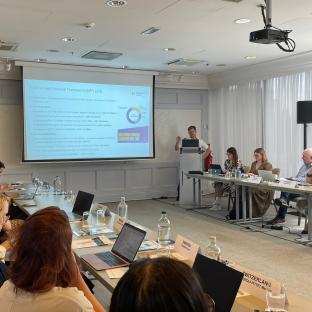
On 30 June and 1 July 2026, Alzheimer Europe welcomed delegates representing 25 national member associations from 23 different countries across Europe, to its Public Affairs meeting in Luxembourg. The meeting was also attended by members of staff from Alzheimer Europe and a representative of the European Working Group of People with Dementia (EWGPWD). Rosário Zincke dos Reis, Chairperson of Alzheimer Europe, welcomed everyone and introduced the agenda.
The agenda on 30 June began with a section on “Involving members in EU policy discussions”, moderated by Jean Georges, Executive Director. He introduced the topic and the speakers:
Owen Miller, Policy Officer at Alzheimer Europe gave delegates an overview of current EU policy priorities and asked whether there would be any interest in forming a dedicated public affairs group, to better involve members in our public affairs work and support them in their work. This was welcomed and Alzheimer Europe will look to set up such a group in the near future.
Margarita Reyes, Project Officer at Alzheimer Europe then presented the upcoming Alzheimer Europe exhibition in the European Parliament in Brussels, noting that this would be an important opportunity to campaign for greater prioritisation of dementia in EU programmes. She highlighted some of our previous policy-related activities (our Prevalence Report, our European Dementia Monitor and our Helsinki Manifesto). She then, discussed why it matters to have such an exhibition now, shared an exhibition walkthrough and the themes as well as other features of the event, and encouraged members to get engaged in this event and to support our communications. She also shared some videos contributed by MEPs, which will form part of an upcoming social media campaign during World Alzheimer’s Month, the first week of which coincides with the exhibition.
Up next, the floor was given to delegates representing national Alzheimer’s associations, to share their experiences in reaching out to and including MEPs in European and national initiatives. There were noticeable differences between countries regarding the ability of members to achieve policymaker engagement, with some of the main issues mentioned being the lack of government funding and interest in some countries, as well as low levels of public awareness and high levels of stigma surrounding dementia. It was clear that some countries needed considerably more funding and support, but also encouraging to see that everyone was very keen to be involved in our policy work and in EU policy discussions.
The next segment of the meeting focused on “Supporting national policy campaigns through European publications and reports” and was moderated by Angela Bradshaw, newly-appointed Deputy Executive Director of Alzheimer Europe. Presentations came from:
Owen Miller, who discussed the upcoming Alzheimer Europe 2026 Yearbook on dementia strategies and the recognition of dementia as a disability. The Yearbook will provide a comparison of current strategies relating to dementia, a topic which Alzheimer Europe last visited in its 2018 Yearbook.
Lukas Duffner, Project Officer at Alzheimer Europe, who presented on the AD-RIDDLE project review of national dementia strategies on timely diagnosis, risk reduction and prevention.
Jean Georges, who spoke about updating our European Dementia Monitor, which is planned for 2027.
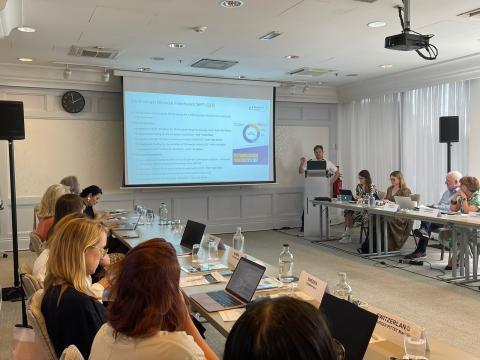
On 1 July, the meeting began with a section on the Alzheimer Europe research portfolio and looked at opportunities for collaboration with national member organisations. Discussions were moderated by Jean Georges, with contributions from:
Angela Bradshaw, who gave an overview of Alzheimer Europe’s involvement in EU research projects, noting the contributions made by the entire team, across four areas: Public Involvement, Stakeholder Engagement, Communications, and Ethical and Policy Reflections.
Faye Forsyth, Public Involvement Officer at Alzheimer Europe, who presented on involving members in a new EU-funded project called ENSURED (Empowering Needs-based Social Health and inclUsive care for RarEr Dementias in moderate to advanced stages).
Lukas Duffner, who discussed the new project DEM-CAPS and the development of a health economic model for psychosocial interventions.
The next and final part of the agenda focused on discussing “What’s in a name? Alzheimer’s disease and dementia - challenges for Alzheimer Europe and national Alzheimer’s associations and Alzheimer Europe”. These discussions were moderated by Angela Bradshaw, who introduced the speakers:
Jean Georges, who spoke about conflicting definitions of the asymptomatic stages preceding mild cognitive impairment (MCI) and dementia.
Dianne Gove, Director for Public Involvement and Ethics and Ana Diaz, Public Involvement Lead (Alzheimer Europe), who shared some feedback from members of the EWGPWD and the European Dementia Carers Working Group, about the new Alzheimer’s lexicon.
The floor was then given to the members, to share their thoughts around communicating about Alzheimer’s disease and dementia in national associations. There was a lot of important discussion and debate, particularly centred around cultural differences and how those can impact on the language used, making it difficult to adopt certain terms across the board.
Rosário Zincke dos Reis closed the meeting and thanked everyone for their valuable contributions to our ongoing work in many areas. We are grateful to everyone who attended, for their hard work, excellent contributions, valued opinions and creative ideas.
Our next Public Affairs meeting is scheduled to take place on 1 and 2 September in Brussels (Belgium).