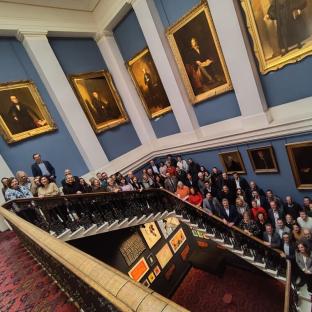
Between 30 and 31 October, the European Alzheimer’s Disease Consortium (EADC) hosted its autumn meeting at the University of Edinburgh, in Scotland. The EADC, in which Alzheimer Europe is an official collaborator, was established in 2001 as a network of research centres of excellence in Europe. Registered as a non-profit association and scientific society, the EADC includes over 60 specialist centres and memory clinics, spread across 20 countries in Europe. Our Director for Research, Angela Bradshaw, attended the meeting, which opened with welcome remarks from Tom Russ (University of Edinburgh), which highlighted the collaboration between the Centre for Clinical Brain Sciences at the University, NHS Research Scotland, and the Alzheimer Scotland Dementia Research Centre. He also cited the work they are doing with the Partners in Research group, which involves people with lived experience of dementia in research. Tom’s introduction was followed by two host lectures highlighting physical multimorbidity in dementia and emerging clinical trial strategies targeting vascular contributions to cognitive decline, delivered by Lucy Stirland and Joanna Wardlaw. Next, a keynote welcome from the Scottish Government’s Cabinet Secretary for Health and Social Care, Neil Gray, underscored national commitment to dementia research, again highlighting the role played by Alzheimer Scotland in developing policies and plans for dementia.
Industry partners from Roche and Eli Lilly presented updates on early-stage therapeutic development and innovations in early detection. The afternoon symposium focused on the growing role of artificial intelligence in neuropsychology, speech analysis, and clinical research. Short scientific reports introduced advancements ranging from biomarker-guided immunotherapy monitoring to expanded genomic and proteomic research initiatives. Day two, held without industry participants, opened with the governance session, including approval of the 2024 financial report and updates on the EADC’s electronic repository and upcoming meetings. Subsequent presentations covered ongoing initiatives such as InRAD, consensus recommendations for anti-amyloid therapy, and proposals for AI-based educational tools. The Young Researcher Symposium showcased emerging work in imaging, fluid biomarkers, cognitive testing, vascular factors, and genetic risk. The meeting closed with presentations from prospective new centres and final remarks before lunch. Learn more about the EADC: https://eadc.online/