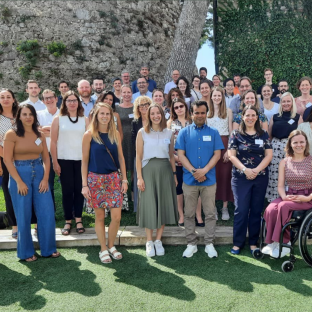
The Horizon 2020-funded PRIME project is investigating how insulin might connect seemingly different diseases, such as diabetes, obesity, obsessive-compulsive disorder, and Alzheimer’s disease. The last time PRIME partners met face-to-face was just prior to the pandemic, in January 2020. Two and a half years later, we were delighted to join the PRIME General Assembly (GA) meeting, which was held in Barcelona, and welcomed colleagues from the 17 partner institutions of the project. The GA meeting was preceeded by a masterclass for Early-Career Researchers (ECRs), led by Angela with participation from Kristien Aerts (European Brain Council), Rosanna Artems (ECNP) and Janette Mostert (Radboud UMC). During the masterclass, panellists discussed tips and learnings for science communication to different audiences, and attendees participated in an interactive workshop to develop short elevator pitches about their research. PRIME brings together a wide range of disciplines and stakeholder groups, including laboratory scientists, clinical researchers, metabolic disease specialists and experts working in non-governmental organisations. The General Assembly (GA) meeting was kicked off by Janita Braalten of Radboud University Medical Center (RUMC), who co-coordinates PRIME with Barbara Franke (RUMC) and Geert Poelmans (Drug Target ID).
The first morning of the GA was dedicated to presentations from workpackages that include studies of clinical data. Work in these WPs is looking at the prevalence, mechanisms and interventions for insulin signalling disorders. The afternoon session was focused on WPs which are dealing with communication, exploitation, ethics and training for PRIME researchers. In addition, EBC organised a brainstorming session to consider the societal impact of PRIME, needs, gaps, priorities and enabling actions, and audiences. The final day of the PRIME meeting was mainly focused on the preclinical research activities being carried out in WP2 and WP3. WP2 is led by Simone Macri (Instituto Superiore di Sanita, Rome), and is focused on mechanism validation and refinement in animal models of disease; WP3, which is similarly looking at mechanism refinement and validation, but in cellular models of disease. Both workpackages have generated interesting results over the last year, identifying potential biological links between obesity and traits such as compulsivity, anxiety and attention. Following these presentations, Geert Poelmans drew the meeting to a close, thanking attendees for their valuable input and contributions.
