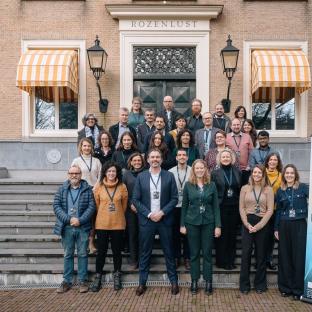
The PREDICTFTD project, a collaborative effort involving 15 European partners, has officially commenced with a successful kick-off meeting hosted by Erasmus UMC in Rotterdam. Coordinated by Prof. Harro Seelaar, the project aims to advance the early detection and diagnosis of frontotemporal dementia (FTD). FTD encompasses a group of disorders characterised by progressive nerve cell loss in the brain's frontal and temporal lobes, leading to significant changes in personality, behaviour, and language. One of the primary obstacles in managing FTD is the often substantial delay in diagnosis, sometimes extending up to three or four years. PREDICTFTD will validate a set of fluid biomarkers and develop a web-based tool which will helps clinicians to diagnose FTD correctly at an early disease stage, also predicting the underlying pathology.
One of the limitations of current biomarker research is that FTD is relatively rare and therefore local FTD cohorts are small. To circumvent this challenge, PREDICTFTD brings together 11 dementia and FTD cohorts from 7 clinical centers, in 5 countries across Europe. By enabling earlier diagnosis, PREDICTFTD hopes to improve outcomes for patients and their families, allowing them to access appropriate support and targeted treatments. The two-day kick-off meeting welcomed partners from PREDICTFTD’s 15 partner organisations, based across 9 countries. Alzheimer Europe, which is leading public involvement and stakeholder engagement tasks, was represented by Angela Bradshaw (Director for Research) and Soraya Moradi-Bachiller (Public Involvement Officer).
The first day focused on partner introductions as well as discussions on how data will be accessed, stored, handled and analysed. On the second day, discussions delved into specific work packages, biomarker development, and the development of economic evaluation models. Clinical partners presented their cohorts and sites, outlining the different biomarker technologies being used in their clinics and laboratories. Drawing the two-day meeting to a close, Prof. Seelaar reminded the attendees about PREDICTFTD's mission to advance early diagnosis of FTD, highlighting how this can provide clarity during uncertain times, enabling individuals to seek appropriate support and interventions promptly. PREDICTFTD is funded by the European Union’s Horizon Europe programme under Grant Agreement No. 01156175.