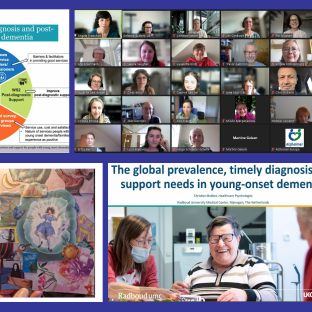
On 4 July, we hosted the latest edition of our Alzheimer’s Association Academy. The Academy meetings are capacity-building workshops for our member organisations, people with dementia and carers, together with researchers, policymakers, industry representatives and other stakeholders. The focus of the Academy meeting was on providing services and support for people with young onset dementia, which affects almost 4 million people worldwide. The term “young onset dementia” (YOD) is used to describe any form of dementia that develops in people under the age of 65. Although YOD is rarer than later onset forms of dementia, there are still 370,000 new YOD cases annually worldwide. And while YOD is similar to other types of dementia in some ways - causing symptoms such as memory loss, changes in mood and personality - the disease can have a different impact as younger individuals are more likely to be employed full time, raising a family or financially responsible for a family.
Also, since health care providers generally don't look for dementia in younger people, getting an accurate diagnosis can be a long and frustrating process. Similarly, services and support may be hard to access, and may not be tailored to the particular needs and preferences of people with YOD. The first Academy speaker was Pia Knudsen, who shared her perspectives on living with young onset dementia. Pia, a member of the European Working Group of People with Dementia (EWGPWD), lives in Denmark and was diagnosed with dementia in her mid-50’s. Pia explained that she is a visual artist, designer and teacher, and spoke vividly about how she felt when she was diagnosed, how her life has changed since her diagnosis, and the way she draws inspiration and new perspectives from her children, students and friends. Through examples of her art, Pia eloquently illustrated the impact of a YOD diagnosis. Next, Christian Bakker (Radboud University Medical Center, the Netherlands) spoke about the global prevalence of YOD, as well as timely diagnosis and support needs in YOD. Christian explained that people with YOD can wait up to 5 years for diagnosis, which makes it much harder for them and their families to access support and psychosocial interventions, which could help build capacity, allowing people to live well with YOD, for longer. Following on in the same theme, Jan Oyebode of the University of Bradford (UK) spoke about the Angela project, which aims to improve diagnosis and post-diagnostic support for YOD. The project included a range of different studies, Jan explained, from interviews with service providers for people with YOD, to Delphi studies, national surveys, and focus groups.
The results highlighted a major lack of service support for people with YOD: almost 40% of people with a YOD diagnosis had not seen a health professional in the last 3 months, and 57% of family members said they provided over 5h of care a day, with little respite support. An important observation was that specialist services for YOD were much better equipped to provide quality care than “all age” services, maintaining activity and engagement with their patients. The last speaker of the Academy meeting was Susanna Saxl-Reisen of the German Alzheimer’s Association (Deutsche Alzheimer Gesellschaft). Susanna spoke about support provided by national patient associations to people with YOD, who number over 100,000 in Germany. She highlighted a broad range of activities targeted at people with YOD, such as support and activity groups, helplines and psychoeducational training and guidance. Supporting families and caregivers is also crucial, Susanna emphasised, explaining how projects such as KIDSDEM and RHAPSODY have created educational materials, care structures and capacity-building workshops. The Academy meeting finished with an interactive roundtable and lively discussions on challenges and enablers for improved services and support for people with YOD.