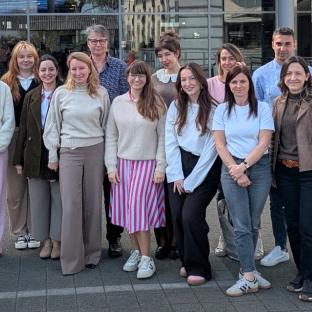
On 1 April, a new EU Joint Programme – Neurodegenera-tive Disease Research (JPND) funded project – ENSURED (Empowering Needs-based Social Health and inclUsive care for RarEr Dementias in moderate to advanced stages) – was launched to address the unmet social needs of peo-ple living with rarer dementias at moderate to advanced stages of disease progression (classed within the study as frontotemporal dementia, Lewy body dementia and vascular dementia).
ENSURED is led by Professor Marjolein de Vugt and Dr Sara Bartels at Maastricht University and involves five part-ners from across Europe: Dublin City University (Ireland), Deutsches Zentrum für Neurodegenerative Erkrankungen (Germany), Alzheimer Europe (Luxembourg), Koç University (Turkey) and Wroclaw Medical University (Poland). EN-SURED has secured EUR 1.56 million in funding and will progress over the next three years. The overall aim is to highlight the unmet need in rarer dementias, which are often under-researched due to a historical focus on Alzheimer’s disease, and to develop interventions and support systems that are attuned to the needs of people living with rarer de-mentias, particularly at moderate to advanced stages. The project builds on a previous JPND funded endeavour (IN-TEREST Working Group), which highlighted a need to pri-oritise social health and inclusivity in dementia research. Two key areas of under-representation were identified by the INTEREST Working Group: research inclusive of rarer dementias and people living with moderate to advanced dementia.
The ENSURED project addresses these issues by 1) priori-tising social health as the end outcome, 2) focusing exclu-sively on rarer dementias and 3) engaging under-represented groups such as those living with moderate to advanced dementia, migrant and socioeconomically disad-vantaged populations. The consortium will achieve this through operationalisation of six work packages (WPs) cen-tred around the WP1 core pillar of Public involvement. Each work package will incrementally and iteratively address an area of unmet need in rarer dementias at moder-ate/advanced stages: monitoring and tracking symptoms, experiences and disease progression (WP2); understand-ing the impacts of rarer dementias on social health and specific needs in special sub-populations (WP3); build on learning from WP2 and WP3 to identify key transitional and turning points in disease progression and care (WP4); de-velop a toolkit to help address unmet needs (WP5). All as-pects of work will be supported by a robust management plan, and programme of dissemination coordinated by WP6.
Alzheimer Europe will lead WP1, developing a framework of Public Involvement for the ENSURED project that consorti-um partners can use to develop ethically sound, respectful and reciprocal Public Involvement. The framework will build on the existing Alzheimer Europe Public Involvement model, iteratively developing the approach to ensure it is attuned to the needs of people with rarer dementias, who often have a diverse range of neurocognitive and physical presentations, and those living with the disease at moderate to advanced stages. Consortium members across WP2-5 will use the framework to guide their local and national Public Involve-ment endeavours, ensuring the project is bottom up and patient-centred.
More information will be available in the coming months, when the project logo and social media pages will be launched. In the interim, more information about the project can be found on the JPND pages here: https://bit.ly/ENSURED_ProjectFactsheet
