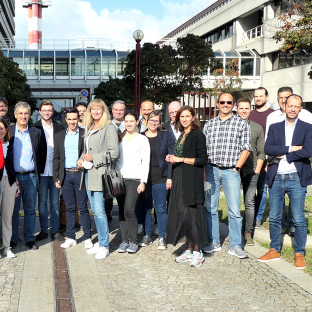
On 7 and 8 October, members of the LETHE consortium gathered in Austria (Vienna) for their second General Assembly meeting.
The event was hosted by the Medical University Vienna and chaired by Sten Hanke (FH Joanneum), coordinator of the project. The meeting focussed on summarising recent project developments and discussing upcoming plans.
LETHE aims to provide a data-driven risk factor prediction model for older individuals at risk of cognitive decline building upon big data analysis of cross-sectional observational and longitudinal intervention datasets from 4 clinical centres in Europe including the 11- years analysis of the FINGER study.
Ten months into the project life, LETHE is still in its first phase. The first day focussed on discussions regarding the technical framework, as well as data flow, the adapted study protocol which aims to follow a similar approach as the FINGER study, the selection of sensor technology as well as on how to approach data harmonization for a retrospective analysis of data that will be contributed by the different clinical partners.
The second day revolved around dissemination and exploitation activities and plans, including a short presentation on Alzheimer Europe’s involvement by Chris Bintener. Apart from the communication, Alzheimer Europe will also be involved in the development of a Health Literacy Portal and involve a Patient Advisory Board in the project.
This was followed on how the project may address its aim to develop an AI-based risk prediction model. Next, partners demonstrated a personal robot that may be used during the trial.
The afternoon of the second day then followed with discussions on the yet to be defined data collection and big data framework. After that, a broader discussion on data protection and health literacy followed. The meeting concluded after a steering committee meeting at which the project coordinator and work Package leaders took some decisions on how to move the project forward.
Learn more about the project:
The LETHE-Project has received funding from the European Union’s Horizon 2020 research and innovation programme under grant agreement no 101017405.