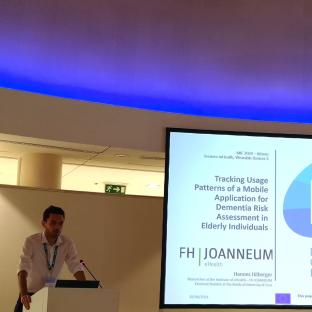
On 28 August, Hannes Hilberger from the institute of eHealth, FH JOANNEUM participated in a session on mHealth, Wearable Devices at the 34th Medical Informatics Europe in Athens, Greece. In this article, he shares about his experience and research. The primary objective of the usage tracking mechanism for dementia risk assessment was to monitor user interaction with the LETHE App. Specifically, this involved assessing whether participants are actively engaging with the application and identifying which features are utilised most frequently.
To achieve this, we tracked a total of 20 different events, which included actions such as screen changes (e.g., opening the calendar) and accessing external resources. By monitoring these events, we could reconstruct the paths that participants take within the app and measure the time they spend using it. Our analysis of usage patterns focused on several tasks. Initially, we assessed overall app usage by converting event data into binary indicators (0 for no usage, 1 for usage) to determine daily engagement levels. Subsequently, we analysed session duration to measure the amount of time participants spent interacting with the app during each session. Lastly, we examined engagement with educational content to identify which resources and which intervention domains captured users' attention the most.
After a six-month period, we found that approximately 39% of study participants used the LETHE App daily. Notably, usage rates were higher among participants in the intervention group compared to the control group. A similar trend was observed for session duration, with the intervention group averaging around 42 seconds per session. Interestingly, participants in the control group engaged with educational resources 41% more frequently than those in the intervention group. Furthermore, personalised features were among the most accessed components of the app, indicating a preference for tailored content over generic external resources. The feedback received at the conference was very positive, particularly regarding the LETHE App, the overall project, and the findings presented in our submission. One common question from attendees concerned the language options available. We clarified that the app is available in multiple languages, more concretely in German, Finnish, Swedish, and Italian. Find out more about the project: https://www.lethe-project.eu/