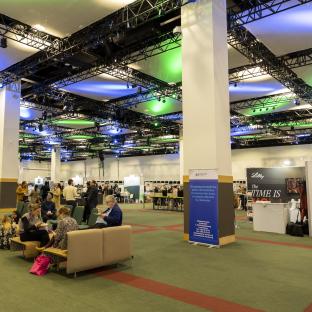
Dublin, 29 October 2026 – Today was the third and final day of the 36th Alzheimer Europe Conference (#36AEC) “Sláinte: Building momentum in dementia through policy, research and partnership” which began on Tuesday 27 October. Today’s programme focused on advances in diagnosis, treatment and care and on building momentum in dementia through research.
Advances in diagnosis, treatment and care
The third plenary of the conference looked at advances in diagnosis, treatment and care and was moderated by Mario Possenti (Vice-Chairperson of Alzheimer Europe, Italy).
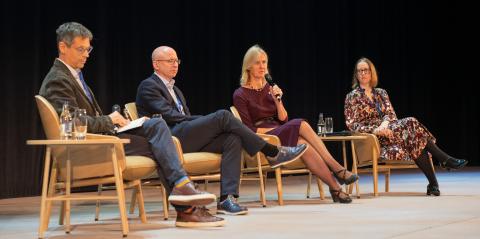
The first speaker invited up to the lectern was Professor Seán Kennelly, a Consultant Geriatrician and Director of the Institute of Memory and Cognition at Tallaght University Hospital, and Clinical Associate Professor of Medical Gerontology at Trinity College Dublin. He presented “The Evolution of Alzheimer’s Disease Diagnosis: From Clinical Uncertainty to Biological Precision and Personalised Care”. Prof. Kennelly stated:
“We are entering a new era in Alzheimer’s diagnosis. Advances in brain imaging and fluid biomarkers, particularly new blood tests, are making it possible to identify the biological changes of Alzheimer’s disease with greater accuracy and potentially at an earlier stage.
“Better tests are one part of better diagnosis. Biomarkers can provide important new information, but they need to be combined with careful clinical assessment and an understanding of each individual’s symptoms, health, circumstances and priorities. Diagnosis should remain a personalised process, involving the person and those close to them.
“Scientific progress must translate into better and more equitable care. The challenge now is to ensure that advances in diagnosis and treatment are accessible across Europe and lead to real benefits for people living with Alzheimer’s disease and their families."
Professor Wiesje van der Flier is Chief Executive Officer of Alzheimer Nederland and also holds an endowed chair at the department of Epidemiology & Data Science of Amsterdam UMC. She took the floor next, with a talk called “Advances in treatment from the perspective of clinicians, patient advocates and patients”.
She highlighted that progress is urgently needed, as patient numbers keep increasing. “As of 2025, an estimated number of 12 million people in Europe are living with dementia. A number that is rapidly increasing, given the ‘greying’ population”. However she also said that “this is a hopeful time, given novel developments in diagnosis related to digital cognitive assessments and blood-based biomarkers, innovative therapies, in particular anti-amyloid therapies, and innovative care concepts, focusing on how patients with dementia can continue to lead their lives in a meaningful way.”
Regarding a broad prevention strategy, she noted that this should entail boosting brain health to prevent the onset of pathology, diagnosing in a timely and accurate manner, leading to personalised medicine to prevent onset of dementia, and “orchestrating care and wellbeing in such a way that helps to prevent severe dementia stages.”
The third and final speaker at this plenary session was Emma Wolverson, a Clinical Psychologist and Professor of Ageing and Dementia at the Geller Institute of Ageing and Memory, University of West London (United Kingdom). During her presentation, “Critical moments in dementia care: advancing research and practice”, she said:
“Dementia care is shaped by a series of critical moments, points at which needs change, important decisions must be made, and timely support can significantly influence outcomes. While diagnosis often receives most attention, many other critical moments remain under-researched and poorly understood.”
Drawing on the work of INTERDEM members, her presentation explored three such moments: mental health crisis, end-of-life care, and support for family carers. She also highlighted recent advances in research and practice, including efforts to better predict and prevent mental health crises, improve palliative and end-of-life care, and support carers through challenging transitions and decisions. She argued that “improving dementia care requires greater attention to these pivotal moments and a stronger focus on prevention, collaboration, and timely intervention.”
Parallel sessions and special symposia
Prior to the first plenary in the morning, delegates were able to choose from a possible ten parallel sessions including one organised by our co-hosts The Alzheimer Society of Ireland, called “From Vision to Practice: How the ASI Is Sustaining Person-Centred Dementia Care Across the Dementia Journey, From Activity Clubs to Home Care” whilst another, “From early diagnosis to impact: What makes dementia strategies work?” was held by the Kuratorium Deutsche Altershilfe, one focusing on “Advancing brain health, research and innovation in Ireland” was organised by Ireland’s Health Service Executive (HSE) and still another, “NEXTGEN - Dementia Justice Immersive Workshop”, was organised by Lorenzo’s House. Other sessions included “Translating research into practice” (moderated by Thanos Chatzikopoulos, Alzheimer Europe Board member, Greece), “Care approaches and services (a series of Quick Oral Presentations, moderated by René Thyrian, Alzheimer Europe Board member, Germany), “National Alzheimer’s associations” (moderated by Petra Tegman, Sweden), “Disabilities & dementia” (moderated by Sarah Campill, Public Involvement Officer, Alzheimer Europe), “Residential care” (moderated by Friederike de Maeyer, Alzheimer Europe Board member, Austria) and “Sexuality & intimacy” (moderated by Dianne Gove, Director for Public Involvement and Ethics, Alzheimer Europe).
Prior to lunch, several symposia took place, including one called “Patient-focused drug development”, organised by conference Gold sponsors Roche and moderated by Sasha Bozeat (Switzerland). Concurrent special symposia included one organised by Fundació Pasqual Maragall and one by Fondation Médéric Alzheimer.
The afternoon saw a further ten parallel sessions, including one from The Alzheimer Society of Ireland, looking at “Amplifying Lived Experience: The Voices of People with Dementia and Carers in Ireland”, one organised by INTERDEM, about “Innovative Methodologies in Dementia (METHODEM)”, one by the AI4Hope project, called “Digital tools for symptom monitoring, management and planning in dementia care” (moderated by Věra Ryšavá, member of the European Working Group of People with Dementia, Czechia), and one by the Global Brain Health Institute (GBHI) called “From Dublin to the World (GBHI)”. Other parallel sessions were: “Other types of dementia” (moderated by Rejko Krüger, Luxembourg), “Brain health and prevention (moderated by Angela Bradshaw, Deputy Executive Director, Alzheimer Europe), “Cost of dementia care & treatment” (moderated by Kevin Rabiant, France), “Minority ethnic groups” (moderated by Rune T. Nielsen, Denmark), “Home care” (moderated by Heike von Lützau-Hohlbein, Germany), and “End-of-life approaches” (moderated by Katariina Suomu, Alzheimer Europe Board member, Finland).
Throughout the day, delegates were able to view poster presentations, exhibited in the Foyer, and to speak to poster presenters about their research.
Building momentum in dementia through research
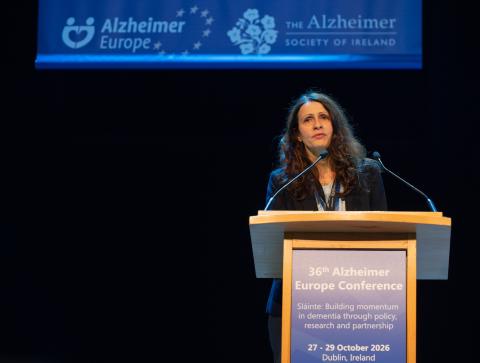
The third and final Keynote Lecture of the conference was delivered by Lorina Naci, Professor of Psychology and leader of the “Consciousness and Cognition” group at the School of Psychology, at Trinity College Dublin (www.lorinanaci.org). During her lecture, Prof. Naci stated:
“The window for dementia prevention opens decades before symptoms appear. Research from the PREVENT Dementia programme demonstrates that subtle changes in brain network organisation associated with genetic risk for Alzheimer’s disease can be detected in cognitively healthy middle-aged adults, potentially opening new opportunities for earlier identification and intervention.
“Genetic risk is not destiny: lifestyle matters. Our findings show that engaging in intellectually, socially and physically stimulating activities is strongly associated with better memory and cognitive performance in midlife, including among people with inherited risk of dementia. Building cognitive reserve is a powerful, accessible component of dementia prevention.
“Dementia prevention must become earlier, more personalised and multidimensional. Understanding how genetic vulnerability, biological sex, lifestyle and brain health interact will help us develop more targeted prevention strategies that strengthen cognitive resilience across the lifespan.”
Slán le Baile Átha Cliath (Goodbye to Dublin) … and Здраво Београду! (Hello to Belgrade)
At the Closing Ceremony, Andy Heffernan, CEO of The Alzheimer Society of Ireland (ASI) thanked everyone for their participation and for travelling to Ireland for the conference, noting the fantastic amount of work put in by Alzheimer Europe staff and his team at The ASI as co-hosts, and the great result.
Maria do Rosário Zincke dos Reis, Chairperson, Alzheimer Europe thanked delegates, speakers, our co-host The ASI, and conference sponsors alike and wished everyone a safe return journey.
Following the official close of the Dublin event, a video was shown as a welcome from the Serbian Alzheimer's Disease Association (SUAB) to everyone present, to join us for the 37th Alzheimer Europe Conference, taking place in Belgrade, Serbia from 12 to 14 October 2027.
Attendees at the closing ceremony were treated to an uplifting and deeply moving performance by Dublin’s Forgetmenots Choir, a dementia and age-friendly community choir.

Alzheimer Europe would like to thank to all delegates who joined us at #36AEC, and we hope to see you next year for #37AEC in Belgrade!
Acknowledgement
Alzheimer Europe gratefully acknowledges the support of all conference sponsors, with particular thanks to Gold sponsors, Lilly and Roche; Silver sponsors, Bristol Myers Squibb and Siemens Healthineers; and Bronze sponsors, BioArctic, Biogen, Eisai, Firalis, MSD and UCB.
