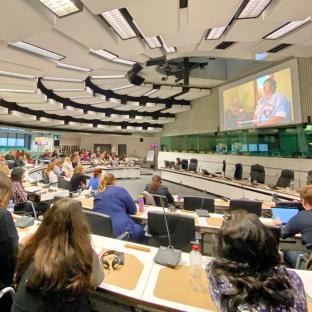
On 30 November, the European Association of Service providers for Persons with Disabilities (EASPD) hosted the European premiere of the documentary “Ukraine: Paused Reforms”. The documentary addresses the realities of persons in vulnerable situations, including persons with disabilities, who have been forced to remain in Ukraine since the outbreak of full-scale war.
According to the UNICEF Ukraine Country Office’s 2021 annual report, Ukraine has one of the highest rates of children in residential care institutions in the world. Since 2017, Ukraine began to implement a deinstitutionalisation reform which aimed to set the country on the path to development of community-based services for children and persons with disabilities. With the onset of the full-scale invasion of the country by the Russian Federation however, many of these reforms were forced to be put on pause. This pause has left thousands of vulnerable people, including many persons with disabilities, who remain in the country, without access to their basic human rights.
Filmed in September 2022, “Ukraine: Paused Reforms” addresses the continuation of institutional services within the country, many of which result in the long-term institutionalisation of their residents. The documentary also highlights the essential nature of support services, regardless of war, and the devastating impact that the unavailability of quality, community-based services have on the lives of people with disabilities. Alongside the documentary viewing the event also hosted two panel discussions.
The first panel looked at the reality of deinstitutionalisation in Ukraine today. A second panel looked at the role of the EU in supporting deinstitutionalisation in Ukraine. The first panel included the participation of Varvara Alybok, a resident at Mukachevo Children Internat in Ukraine. At the age of 33 she remains a resident of the institution but spoke of her desire to live independently and live her own life. Halyna Kurylo of DRI Advocacy Ukraine, highlighted the continuation of a medical model of disability in Ukraine, which defines the institutional system and too often leads to the long-term institutionalisation of many people who are in vulnerable situations. Ms Kurylo reminded the room that institutions are not compatible with human rights and stressed that lives of people living in institutions cannot be put on pause even in times of war. Looking to the reconstruction of Ukraine, Eric Bloemkolk from the SOFT Tulip Foundation, stressed the need for the EU and other key actors to include persons with disabilities in the reconstruction process, making them not only recipient of services, but also co-creators of a more inclusive Ukraine.
The final panel included representatives of Ukrainian government, who expressed the government’s commitment to deinstitutionalisation. Uliana Tokarieva, Deputy Minister of Social Policy of Ukraine spoke of the need to build back better, which included the adaptation of legislation and targeting resources to community-based services throughout the country. Daria Herasymchuk, Advisor and Commissioner of the President of Ukraine on Child`s Rights and Children Rehabilitation maintained that Ukraine’s path towards deinstitutionalization has not stopped in the face of war, but continues to make progress, albeit at a slower pace. With the country currently baring the repercussions of the full-scale invasion, which includes regular cuts to power and a scarcity of gas during the winter month, Ms Herasymchuk, also stressed the need for additional international support to ensure that this progress is sustained. Speaking at the launch of the event Maya Doneva, EASPD Secretary General, said “The rights of the country's most vulnerable must not be forgotten, even at times of war. EASPD urges the Ukrainian government to work with key international partners as well as local organisations who are implementing community-based services to continue Ukraine’s path towards deinstitutionalisation.” To watch the documentary, click here. To watch the panel discussions, click here.
