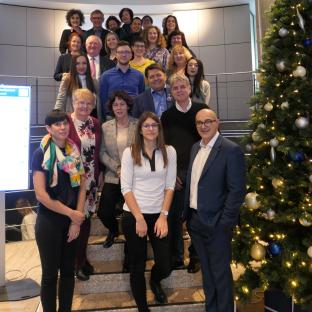
On 10 and 11 December 2019, Alzheimer Europe hosted the fifth edition of its annual Alzheimer’s Association Academy. Participants included 24 representatives from AE member organisations; 3 company representatives and 8 AE staff members. There were 15 expert speakers from various institutions and organisations across Europe and from different European projects.
The first day began with a session on “Models of patient engagement in dementia” and was moderated by Annette Dumas (ASDM Consulting, Belgium). This session included presentations by Javier Téllez (GMV, Spain), who spoke about citizen science - the role of online cognitive tests for the detection of dementia; Lena Sannemann (University Clinic Cologne, Germany), who discussed involving general practitioners in dementia diagnosis; and Andreea Ciudin (VIHR, Spain), who joined us via tele-conference, to explore the role diabetologists might play in the diagnosis of dementia.
The second session of the day was on “Ethical issues in dementia research” and was moderated by Amy Dalrymple (Alzheimer Scotland). This session included presentations by Marthe Smedinga (Radboud University Medical Centre, Netherlands), who shared some of the ethical challenges in the area of timely detection and disclosure of genetic and biomarker risk; and Dianne Gove (Alzheimer Europe), who looked at ethical considerations for inclusive participation of people with dementia in research.
Day two of the Academy began with a session on “Involvement of patients and patients’ organisations in medicines development and research”, which was moderated by Ana Diaz (Alzheimer Europe). This session included presentations by Camilla Habre (European Patients’ Forum, Brussels), whose talk was on patient engagement in medicines’ development, in the context of the PARADIGM project; Ana Diaz (Alzheimer Europe), who informed participants about the RADAR-AD project’s Patient Advisory Board; Nicole Goedhart (Athena Institute, VU Amsterdam, Netherlands), exposed some of the existing gaps in patient engagement in medicines’ development; and Lidewij Eva Vat (Athena Institute, VU Amsterdam, Netherlands), who asked participants to consider “what’s in it for me?”. She evaluated the impact of patient engagement within the PARADIGM framework.
The second morning session, was on “The role of new technologies in the diagnosis and prognosis of Alzheimer’s disease” and the moderator was Iva Holmerová (Czech Alzheimer’s Society, Czech Republic and Alzheimer Europe). This session included presentations by Kim Baden-Kristensen (Brain+, Denmark) and Younes Tabi (Oxford University), both of whom presented different aspects of the AD Detect and Prevent project; and Andrew Owens (King’s College London, United Kingdom), with a talk on the potential of mobile and digital technologies to improve the assessment of Alzheimer’s disease, in the context of the RADAR-AD project.
The final session of this fifth Academy was titled “Empowering people with dementia” and was a combination of two presentations and two consultations with the Span+ project. The two speakers, Annemiek Bielderman and Charlotte van Corven, from the Radboud Medical Center in the Netherlands, discussed “defining empowerment for people with dementia from multiple perspectives” and “Development of the SPAN+ empowerment intervention for people with dementia”, respectively. The workshops explored some of the same topics raised during the project’s already-completed Dutch focus groups, so as to cast a wider net, capturing feedback from across Europe.
The two-day Academy was a very interactive event, with many interesting and thought-provoking discussions. Given the success of its Alzheimer’s Association Academies to date, AE will host a sixth edition on 8-9 December 2020.
