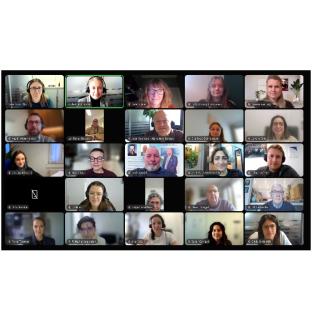
On 17 November 2026, Alzheimer Europe held a session of its online workshop series the Alzheimer's Association Academy, entitled “Inclusive workplaces: Navigating dementia, disability and care in employment”. These capacity-building workshops bring together representatives of national Alzheimer’s associations with members of the European Working Group of People with Dementia (EWGPWD), the European Dementia Carers Working Group (EDCWG), the INTERDEM Academy, as well as representatives from pharmaceutical companies, to learn about dementia advocacy, care, policy, research and treatment.
Kate Boor Ellis, Communications Officer at Alzheimer Europe chaired the session of 17 November, for which there were 67 registered participants from 21 countries and four companies (Bristol Myers Squibb, Johnson & Johnson, Lilly and Roche).
Jan Runar Eliassen, a member of the European Working Group of People with Dementia, delivered a first-hand account of his lived experience of receiving a diagnosis of young-onset dementia at just 45 years old. He was working at the time and lost his job very quickly after being diagnosed, which had a devastating impact on him, his wife Marion and their five children. Along with his job he lost a lot of his sense of identity and his confidence. He would have preferred to continue working and to be allowed to adapt his role to his evolving illness, so as to continue contributing for as long as possible.
Deanie Van Tuijl from Alzheimer Nederland was the next speaker. She is a healthcare entrepreneur within the field of elderly long-term care in the Netherlands and, as Impact Director of the foundation DemenTalent, she works to put DemenTalent, a national volunteer platform, on the map. With help from the Ministry of Health, Welfare and Sports, the aim is to have 50,000 people with dementia in the Netherlands active again by the year 2030, and to help change the way people think about and interact with people with dementia in their communities and in wider society. She presented the platform, which was launched two years ago, and explained how it has developed and the many ways in which people with dementia are empowered to continue meaningfully contributing to their communities through the volunteer work offered. She also shared plans for upscaling and for going international with the concept.
Helen Quinn, Senior Knowledge Officer at Alzheimer’s Society in the United Kingdom gave a presentation on “Work and dementia: legal rights and barriers in practice”. The Knowledge team at Alzheimer’s Society specialises in legal and rights issues, supporting staff with dementia-related technical queries, as well as keeping the Alzheimer’s Society’s factsheets and digital content relevant and up to date. Whilst the presentation focused on the UK, much of what was shared may also be applicable in other countries, especially regarding some of the barriers people encounter and the reasonable adjustments, possible solutions and supports the could be put in place by employers.
Holly Shorey, Policy and Advocacy Officer at Eurocarers, shared some updates on current EU actions and opportunities to close the gender care gap and promote work-life care balance for informal carers. Eurocarers is a European network bringing together carers' organisations as well as universities and research institutes working on informal care across 26 countries. She spoke about what is happening in the EU, including a recent European Parliament report on “Advancing towards a care society: addressing the gender care gap” (May 2026), and shared what Eurocarers is doing to help close the gender care gap, as well as their recent position paper on work-life care balance and flexibility. Alzheimer Europe is pleased to support this work, including as a co-signatory of the position paper and providing support for the surrounding campaign.
Haydn Hammersley, Social Policy Coordinator at the European Disability Forum (EDF), was the final speaker. His role includes coordinating EDF’s work on the European Strategy on the Rights of Persons with Disabilities and his presentation looked at the disability employment package, a flagship initiative by the European Commission under this Strategy. He explained what has been delivered so far and what remains to be done. The Commission is organising thematic stakeholder events, including one on 2-3 November in Poland, at which employers, including several large household-name global companies joined public employment services to discuss what employers are doing to welcome workers with disabilities and how to improve things. They came up with some key lessons around how to ensure they can attract and retain workers with disabilities, as well as how to make reasonable accommodations for existing employees. Oftentimes there are simple and affordable (even free) ways to implement better practices in these areas. Management needs to be willing, and can be provided with information and suggestions, if they are open to making the effort to make a few changes.
Following each of these engaging and insightful presentations, there was an opportunity for the audience to ask questions.
We trust that our Academy delegates enjoyed this online event and we would like to say a huge thank you to all our speakers and to our Gold and Silver sponsors, Bristol Myers Squibb, Eisai, Eli Lilly and Company, Johnson & Johnson, and Roche as well as to the European Union’s Citizen’s, Equalities, Rights and Values (CERV) programme, without whom our Academy sessions would not be possible.
Our next online Academy will take place on 19 January 2027 and will focus on our Dementia in Europe Yearbook 2026.
