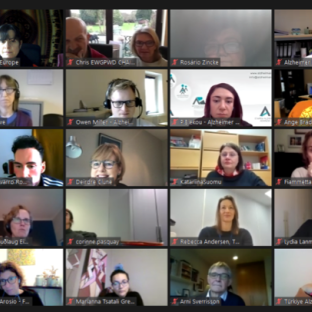
On 9 December, Alzheimer Europe hosted an online European Parliament workshop, drawing its 2020 Alzheimer’s Association Academy series to a close. Chaired by Sirpa Pietikäinen, MEP (Finland), Chairperson of the European Alzheimer’s Alliance (EAA), the workshop included presentations from Alzheimer Europe staff, Members of the European Parliament (MEPs) and European Commission representatives. The event was attended by EU policymakers, representatives from national Alzheimer’s associations and national health ministries, pharmaceutical companies and members of the European Working Group of People with Dementia. The theme for the Workshop was the impact of the COVID-19 pandemic on people with dementia, their communities, healthcare systems and dementia research, as well as the need for dementia to remain a priority for the EU. MEPs Deirdre Clune and Mark Angel, Vice-Chair and member of the EAA respectively, kicked off the workshop by welcoming attendees to the meeting.
Dianne Gove, (Director for Projects at Alzheimer Europe) then described how the pandemic has negatively affected people with dementia and their communities, which have been hardest hit by COVID-19. In some EU countries, between 20-30% of COVID-19 deaths have been in people with dementia. In addition, many people with dementia have experienced an increase in feelings of loneliness and confusion, as well as a deterioration in symptoms. Dianne also emphasised the negative impact that loss of routine and contact with family and friends has had for people with dementia, placing them at greater risk for self-neglect and abuse.
Angela Bradshaw (Project Officer at Alzheimer Europe) looked at how healthcare systems have been stretched during the pandemic, leading countries to call up retired clinical staff and transforming standard wards into COVID-19 intensive care units. This has required additional investments from central governments, as described in the recent “Health at a Glance: Europe 2020” report from the Organisation for Economic Co-operation and Development (OECD) and European Commission. Alongside this, many national Alzheimer’s Associations have made heroic efforts to continue their support of people with dementia, providing online services and helplines as well as accessible resources and guidance. Angela described how dementia research has suffered during the pandemic, with the closure of research laboratories and the cessation or delay of numerous clinical studies. In the longer term, surveys indicate that many early-career researchers are considering leaving dementia research, with legitimate concerns that this area will be deprioritised in favour of infectious diseases research.
Owen Miller (Policy Officer at Alzheimer Europe) then introduced the new Alzheimer Europe policy report, “Dementia as a European Priority – a Policy Overview”. This electronic report takes stock of dementia policy at EU level and lays out recommendations for future priorities. Describing how Alzheimer Europe has worked with its members and partners over the last three decades, Owen outlined some of the recommendations from the report, including the need for dementia research to be prioritised in EU research programmes such as Horizon Europe, and for dementia to be prioritised in policies on disability, chronic diseases, mental health and ageing.
Next, Isidro Laso Ballesteros, Cabinet Expert for Mariya Gabriel (EU Commissioner for Innovation, Research, Culture, Education and Youth) spoke about dementia as a priority of the current and future research programmes of the EU, highlighting the breadth of dementia research that has been funded by Horizon 2020, and lauding the efforts of the Innovative Medicines Initiative (IMI) in developing new diagnostics, tools and treatments for dementia. The last speaker, Stefan Schreck, Adviser to the European Commission Health & Food Safety Directorate General, outlined how the proposed EU4Health programme will provide opportunities to strengthen health systems and promote best practice, providing a route for dementia to be addressed as a priority for the EU. Drawing the workshop to a close, our host Sirpa Pietikäinen moderated a question and answer session, emphasising that the 95 members of the EAA will continue advocating for people with dementia and their carers at EU level.