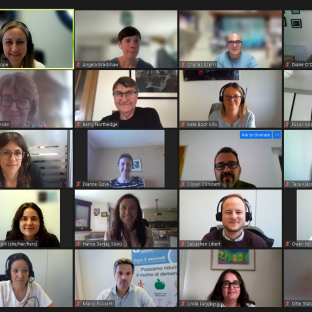
On 17 September 2024, Alzheimer Europe held a session of its popular online Alzheimer’s Association Academy, with presentations from European and US experts, as well as questions from our member organisations. The session provided a detailed update on the current landscape of these therapies and their integration into clinical practice. Angela Bradshaw, Director for Research at Alzheimer Europe, outlined recent regulatory developments and Alzheimer Europe’s position, emphasising the need for clear communication of risks and benefits to support informed decision-making by patients and families. She highlighted the importance of investment in healthcare infrastructure to ensure access to these therapies. Read the Alzheimer Europe position paper here: https://www.alzheimer-europe.org/resources/publications/anti-amyloid-therapies-alzheimers-disease-alzheimer-europe-position-paper
Frank Jessen from the University Clinic Cologne (Germany), presented the position of the European Alzheimer’s Disease Consortium (EADC) following the recent announcement that the Committee for Medicinal Products for Human Use (CHMP) of the European Medicines Agency (EMA) had issued a negative opinion on the marketing authorisation for lecanemab. This negative opinion was issued in July 2024, due to concerns that the observed benefits did not outweigh the risks, particularly due to serious adverse events like amyloid-related imaging abnormalities (ARIA). However, Frank Jessen emphasised that lecanemab and donanemab are significant milestones in Alzheimer's research, as the first antibodies to show clinical efficacy in early-stage Alzheimer’s disease. He noted that these treatments are part of a broader Alzheimer treatment pipeline, which will likely evolve to focus on combination therapies and precision medicine. He also called for mandatory real-world data registries to monitor treatments and ensure the collection of comprehensive safety data. Read the EADC position statement here: https://link.springer.com/article/10.14283/jpad.2024.153
Jason Karlawish from the Penn Memory Center, University of Pennsylvania (US), shared his experience in integrating anti-amyloid therapies into clinical care in the US. He stressed the importance of patient-centred approaches and rigorous monitoring of side effects, especially considering the risks associated with ARIA. He and his colleagues at the Penn Memory Center have established specialised teams to ensure that patients are carefully evaluated and supported during treatment. Jason Karlawish also emphasised the need for the US Food and Drug Administration (FDA) to develop a Risk Evaluation and Mitigation Strategy (REMS) for lecanemab, which would address safety concerns by establishing strict protocols for patient monitoring and care. Read more on the REMS discussion here: https://www.statnews.com/2023/06/16/the-fda-needs-a-risk-evaluation-and-mitigation-strategy-for-alzheimers-drug-lecanemab/
These developments are particularly relevant for the European dementia community and patient associations, as equitable access to future therapies and a focus on precision medicine become critical priorities. Alzheimer Europe's next Academy session is scheduled to take place on 19 November 2024.