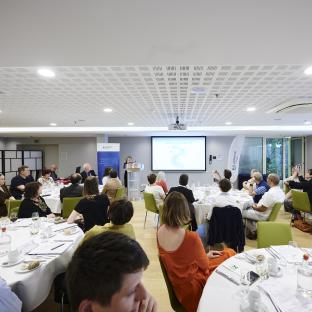
Alzheimer Europe welcomed attendees to its lunch debate on 6 June 2022 in Brussels, Belgium. The session explored the relationship between modifiable risk factors and dementia, with stakeholders representing national member organisations, national ministries, industry partners, policy makers and the European Working Group of People with Dementia (EWGPWD) in attendance. A total of 85 people attended the lunch debate in person, with a further 148 joining on line.
Milan Brglez MEP (Slovenia), a member of the European Alzheimer’s Alliance (EAA) hosted the session and opened by highlighting the importance of modifiable risk factors and primary prevention in relation to dementia – especially in light of the lack of a cure or disease modifying treatment. He further noted that as research reveals more about the underlying diseases which cause dementia, the associated risk factors become better understood, which have demonstrated that conditions such as Alzheimer’s disease, physical changes occur in the brain many years before symptoms manifest – interventions therefore need to be targeted at this stage of the condition. Modifiable risk factors cover a number of key social determinants throughout the life course and are often not specific only to dementia, therefore there is a need for greater focus to be placed on primary prevention, identifying how we can minimise risk factors and decrease the risk of developing dementia.
Mr Brglez spoke of the role of decision makers and elected members at a European level, outlining the importance of their role in providing funding for research and interventions through programmes such as Horizon Europe and EU4Health, and support for initiatives to raise awareness amongst the public about risk factors and adopting a brain health approach across the life course.
The Lancet Commissions on Dementia
Gill Livingston, Professor of Psychiatry of Older People, University College London, presented on risk factors for dementia, based on the two Lancet Commissions on dementia, noting that a third Commission was under development. Her presentation focused on why dementia can be considered as preventable, what some of the key risk factors are and what should be done in response. Setting out the context, it was noted that there has been an increase in the number of people overall living with dementia, whilst at the same time there has been a decrease of 20% in the incidence, though in some countries it remains stable or is increasing. Improvements have mostly been in high income countries and amongst men.
Key mechanisms related to this are though to be cognitive reserve, the ability to tolerate brain changes without developing dementia. It was noted that there is sufficient evidence to identify 12 risk factors for dementia: less education, peripheral hearing loss, hypertension, obesity, traumatic brain injury, excessive alcohol, smoking, depression, physical inactivity, air pollution, social isolation and diabetes. These risk factors account for 40% of current risk factors (as a population attributable fraction), with the largest single risk factor being hearing loss (8%), followed by education (7%) and smoking (5%).
Changing risk factors changes the outcome for developing dementia. It is especially important to target those at risk as trials have tended to take people at lower risk (i.e. those with higher education, higher income). Based on a follow up study involving health economists, if interventions in midlife for hearing aids, hypertension and smoking cessation were undertaken in England, it is estimated there would be an 8.5% reduction in prevalence and save GBP 1.8 billion per year. However, early interventions for diabetes were not cost effective in relation to dementia prevention alone.
The Lancet Commission’s research has been used in the USA and in 2021 a goal was added for the reduction of 10 potential risk factors, with policies developed aiming to reduce prevalence by 15% per decade. The presentation was concluded by calling for stakeholders to be ambitious in prevention, noting that the development of new treatments did not remove the need for prevention and that by tackling risk factors, it provided more years of healthy life, could prevent dementia from occurring and saved money.
Environmental risk factors for dementia
Tom Russ, Consultant Psychiatrist & Honorary Clinical Reader, University of Edinburgh, presented on environmental risk factors for dementia, covering what causes dementia, why studying environmental factors is important and which matter the most. Referring to the Lancet Commission, it was noted that in 2020 air pollution was added as risk factor. The strength of the resource for distinguishing between potentially modifiable factors and unknown risk was highlighted, as was its adoption of a life course approach, explaining the different risk factors at different stages of life.
Citing a paper which examined Bonavista Bay, Newfoundland, Canada, which showed a north/south divide (based on place of birth) in the number of people who died from dementia, with many more people developing the condition in the north. Additionally, he referred to his study which examined the north/south divide in Sweden, using data from the twin study, which examined people over 65 who had developed dementia, also showing significantly more people in the north had developed dementia. It was noted that this pattern has been noted in many countries.
There is a limitation to reviewing scientific literature for risk factors, as there may be risk factors which have not yet been studied. From his review of the existing evidence, some of the key environmental risk factors include: rural living, air pollution, metals (aluminium, fluoride and silicon) vitamin D levels, pesticides and electromagnetic fields. In relation to policy development, it is crucial to bear in mind that some of these risk factors relate to personal choice, whilst others are outwith the control of individuals.
Examining differences between high (HIC) and low & middle income (LMIC) countries, it appears that there is greater risk for developing dementia for those in rural areas in LMICs. For air pollution, there is a useful article “The polluted brain” published in 2017 which explains how pollution affects the brain. The air pollution policy landscape is extremely complicated, however, its potential impact for health policy (not only dementia) is considerable. In relation to water, using data from Scotland, higher levels of aluminium and fluoride, even in safe levels, are associated with a higher risk of dementia. Additionally, there appears to be an association with lower levels of vitamin D and higher risk of dementia.
The ADAIR project
Katja Kanninen, Professor, Faculty of Health Sciences, A.I. Virtanen Institute for Molecular Sciences, University of Eastern Finland, introduced the ADAIR (Alzheimer’s disease Air Pollution) project and some of its preliminary findings. The project involves eight countries across Europe and multidisciplinary researchers, aiming to:
1. Identify biomarkers of air pollution
2. Correlating exposure biomarkers to Alzheimer’s disease risk
3. Assess air pollution exposure induced health impacts on the molecular and cellular level.
The context of air pollution and adverse health was set out, including World Health Organization (WHO) figures which suggest that 90% people breath polluted air, with air pollution linked to 6.7 million premature death. It was noted that policies to reduce air pollution offer benefits for both the climate and health. However, cellular and molecular processes altered by air pollution are not well understood, nor is the link to dementia. Through controlled acute exposure to air pollution, the project was able to identify significant changes to blood plasma, specifically immune cells strongly reacting and, amongst other things, increasing biological processes relating to inflammation. In relation to long-term exposure, a longer-term study of over 18,000 individuals aged over 40 showed that exposure to air pollution was associated with several metabolites in the blood, including sphinganine which is associated with inflammation and immunity, which may increase the risk of Alzheimer’s disease.
An impaired sense of smell is known to be an early sign of Alzheimer’s disease and as part of the research, olfactory mucosa samples (tissue from the top of the rooftop of the nasal cavity which is in direct contact with the brain) were collected and analysed. This tissue is already altered in individuals with persons with AD and additionally, in persons with AD, shows a stronger response when exposed to air pollution. Concluding, it was highlighted that the project has identified new air pollutant exposure biomarkers in both acute and long-term exposure to air pollution. These are useful in identifying individuals who have been exposed to air pollutants and work is ongoing to understand how these relate this to AD.
Flemish public health campaigns
Jan Steyaert, Scientific Officer of the Flemish Centre of Expertise on Dementia, presented on how to turn research recommendations into practical awareness campaigns and policy actions, based on some of the work taking place in Flanders. The prevalence of dementia in Flanders is approximately 125,000 and is expected to rise to 190,000 by 2040.
In Flanders, as elsewhere, there is a demographic challenge. By 2040, the labour market will rise by approximately 3%, whilst the pension population will increase by 25%. In Wallonia, there will be a 3 % decrease and 35% increase respectively. Focusing on prevention is important as there is a potential to lower the number of people with dementia, including the reduced costs in healthcare, as well as the reduction of the number of informal carers. Additionally, as the availability of medicines is still a number of years away, coupled with the ageing demographics, the need to act based on the Lancet Commission findings is evident. However, there is a low awareness amongst the public of modifiable risk factors and there is a need to translate the findings of such research to a public campaign. There have been two such awareness raising campaigns in recent years in Flanders.
In September 2018, “SaniMemorix” was launched and was also available in Germany, Netherlands and Norway, which made vaccine boxes, 50,000 which were distributed, as well as information and resources to pharmacies, as well as information for professional bodies about how to talk to people about dementia. This campaign increase awareness about modifiable risk factors from 35% to 44% amongst 40 to 75 year olds. A second campaign was launched called “Two for the price of one” (2 voor de prijs van 1), which focused on what is good for your heart also being good for your head. Resources and materials included postcards, paper bags distributed to pharmacies and apples with the message printed on them. All of this is open access and are invited to contact the Expert Centre if they wish to use them.
Key lessons learned during the campaign was not to blame the victim, as there are many environmental factors outwith the persons control. Additionally, choices people make are social and not necessarily individual. Additionally, Alzheimer’s organisations need to build relationship with public health organisations. Reaching out to the public is clearly important but so is reaching and engaging with intermediaries including the press, GPs and neurologists. Finally, it is essential to reaching out to high risk groups, such as people with low education, people with migration backgrounds etc., for working with GPs and health insurance companies.
Questions and answers
Alzheimer Europe Board Member, Mary Frances Morris, asked about the mechanism in the brain behind hearing loss and dementia, citing her own experience caring for her father. Prof. Livingston explained that the mechanism is complicated, noting that people with uncorrected hearing loss experience atrophy of the temporal lobe of the brain, however, one of the main mechanisms relate to the lack of cognitive stimulation, as well as the social isolation which often comes about as a result of hearing loss. Additionally, where you have to expend energy and focus on listening, it then leaves less capacity for engaging and responding to dementia.
An online question was asked, in relation to the difference in male versus female risk factors for developing dementia. Prof. Livingston noted that women were more likely than men to develop dementia, however, that this was not true in some sub populations (e.g. in higher education or higher income groups). Whilst some think it is related to the menopause, people who take hormone replacement therapy are just likely or more likely to develop dementia, therefore it is not likely correlated, with socioeconomic status much more likely to explain the differences.
Alzheimer Europe Executive Director, Jean Georges, thanked all the speakers for their excellent presentations and the evidence provided for preventing dementia to be prioritised by decision makers at a European level. He asked Milan Brglez MEP, how to prioritise dementia, given that it was not given significant attention within European Commission work programmes. Mr Brglez noted that this was not an easy question and highlighted that dementia had been included in the Parliament’s position on the European Care Strategy (which he was a co-rapporteur, with Sirpa Pietikäinen MEP). He noted that when Committees produce an own initiative report, it is necessary to engage early in the process. He also noted the importance of engaging with candidates who were standing for re-election and to use the opportunity to ask candidates to give their support. Additionally, he noted that the newly formed sub-committee on health would useful place for the issue to be raised, especially as dementia is an issue which is cross party.
Štefanija Zlobec, President of Spomincica, added that in the run up to the European Parliament elections in 2024, this was an important opportunity for associations to raise awareness, engage with the media and to work to prioritise dementia. Chris Roberts, Chair of EWGPWD, noted the disparities in access to medicines and support across European countries, noting that dementia is used as an umbrella term for more than 200 different distinct conditions. He suggested that potentially there would be greater access to services and supports if the specific kinds of dementia were identified and talked about, instead of using dementia.
Closing remarks
Alzheimer Europe Vice-Chair, Charles Scerri, thanked the four speakers for their presentations, noting that the presentations clearly set out the science and knowledge of these risk factors, as well as an example of how these messages can translate into public messages to promote prevention. He further highlighted that is up to governments and our organisations to clearly articulate this message to the public and to shift the paradigm of prevention to younger populations. This brain health approach across the life course must become an integral part of our work.
Presentation to Helen Rochford-Brennan
A presentation was made, marking Helen Rochford-Brennan’s time as a member of the EWGPWD (from 2014-2022), including serving as its Vice-Chair from 2014-2016 and Chair from 2016-2022. Charles noted that Helen had been an active and passionate campaigner both in her home country and at a European level for many years highlighting her tireless work over the years, sharing her personal experience of living with dementia, her professional experience and her many talents for the benefit of Alzheimer Europe, the EWGPWD and numerous researchers and policy makers. He noted that anyone who has had the privilege of working with Helen would attest to her insight and thoughtful contributions, which has unquestionably strengthened Alzheimer Europe’s work. Helen gave a short speech recounting her time as part of the EWGPWD, noting that it had been an honour and a privilege to be part of the group, and highlighting some of the key research projects in which she had been able to participate.
Helen also spoke of her immense pride in being able to discuss and raise the issue of human rights during her time with the group, including delivering speeches in the European Parliament. She also spoke of the early meetings of the EWGPWD and her friendship with Agnes Houston, Helga Rohra and Hillary Doxford. She extended thanks to the Alzheimer Europe team for their help and support, as well as the board for their ongoing support and for fostering an inclusive environment, allowing her to thrive. She also thanked the European Parliament and Commission for its support, as well of that of the sponsors, which made Alzheimer Europe’s work possible.
In particular, Helen acknowledged the support of EAA member Deirdre Clune MEP (Ireland) who has long supported making dementia a priority. Finally, she thanked the Alzheimer’s Society of Ireland for nominating her and providing the support to allow her to take part in the group. Helen concluded by describing her time with the EWGPWD as one of the most enriching her life and reflected on the progress that had been made and the knowledge that had been shared. She paid tribute to past members of the group, including those who were no longer with us, and their invaluable contributions. She stated that the best way to honour their legacy was by continuing to strive for advancement in dementia research, care and support. Her final thanks were to her supporter Carmel Geoghegan who has provided support over the years. She praised her dedication and compassion despite her own challenges and noted how it had been greatly appreciated by her, her late husband Sean and her son Martin.
The videos of the presentations from the lunch debate can be watched here: https://www.youtube.com/playlist?list=PLO-PgQHI1WQUxce6AhLko7ffp4QSBkXzO