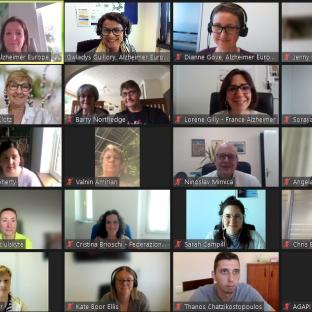
Alzheimer Europe regularly organises Alzheimer's Association Academy meetings, meant as informative workshops aiming to build the capacity of our member organisations. On 16 July, Alzheimer Europe organised a session dedicated to palliative care for people with dementia, which was hosted by Ana Diaz (Public Involvement lead at Alzheimer Europe). During this interactive meeting, four speakers shared their insights into the concepts and perception of palliative dementia care, Advance Care Planning, the role of novel technology in the provision of palliative care and the lived experience of caring for a loved one with dementia at the end of life.
The session was kicked off by Professor Jenny van der Steen, who is the chair of the Taskforce on Advance Care Planning of the European Association for Palliative Care. She presented about the importance of Advance Care Planning (ACP), defined as the “process of communication about future care and treatment preferences, values and goals with the person with dementia, family, and the healthcare team”. She shared the results of a Delphi consensus study about specific issues arising for ACP in dementia, which had been conducted between September 2021 and June 2022. Jenny underlined that the role of the person with dementia throughout the ACP process may change, owing to progressive difficulties in communicating, a decline in mental capacity and changing roles and involvement of the family. She further noted that discussions about ACP may also include treatment preferences for the end of life and that such discussions can already start outside of the healthcare setting.
Next, Professor Lukas Radbruch, who holds the Chair of Palliative Medicine at the University of Bonn, presented about the “Artificial Intelligence based Health, Optimism, Purpose and Endurance in Palliative Care for Dementia” (AI4HOPE) project. AI4HOPE aims to assess whether and how novel technology can support and enhance palliative dementia care. In particular, the project will assess the feasibility of using physiological measures such as heart rate variability and facial emotion recognition to help monitor pain and distress in people with dementia. These could then be coupled to computerised psychosocial interventions, such as music therapy. Technologies developed within AI4HOPE are not meant as a replacement for human interaction and touch, but rather as enhancements aimed to complement the palliative care process. Lukas furthermore emphasized the need to tackle the stigma associated with the term “palliative care”, which entails enhancing the quality of life of people living with an incurable illness such as dementia throughout the entire disease spectrum – not only at the end of life.
Dr Dianne Gove (Director for Public Involvement and Ethics at Alzheimer Europe) presented insights gathered from Alzheimer Europe’s national member organisations, members of the European Working Group of People with Dementia and the European Dementia Carers Working Group, regarding their perception of the palliative care concept. She outlines that the term “palliative care” has traditionally mainly been linked to oncology. Even though the concept is in fact much broader than this, “palliative care” continues to be associated with the process of dying. This may be reinforced by the fact that in some countries, palliative care is only provided by hospices. A lack of familiarity with the term and a poor understanding of what palliative care entails may additionally contribute to fear and avoidance. Dianne concluded that governments and care providers should recognise that people with dementia are entitled to palliative care and improve equal access to it.
Next, Paddy Crosbie (member of the Irish Dementia Carers Campaign Network and member of the European Dementia Carers Working Group) shared his experiences caring for his partner Derek, who sadly passed away in 2021. Paddy noted that even though the concept of palliative care can seem daunting at first encounter, for him personally, it also has a positive and comforting connotation, given his personal experience of it. He appreciates the fact that he himself was also included and looked after in the care process. Paddy furthermore noted that changing the term “palliative care” may not serve its purpose, as many people, especially in the later phases of the lives of their loved ones, derive comfort from it. Changing the terminology, he noted, may also dilute such positive expectations. The session concluded with a discussion about the meaning of “palliative care”, its appropriateness for people with dementia and necessary changes/improvements regarding terminology and the care process.
