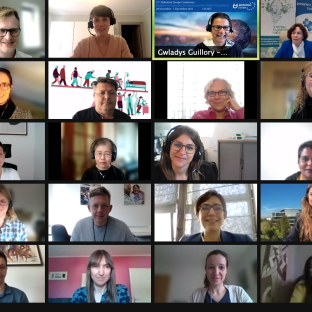
On 19 October 2021, Alzheimer Europe held an online session of its popular Alzheimer's Association Academy series. These Academy sessions have been running since December 2015, bringing together the member associations of Alzheimer Europe, members of the European Working Group of People with Dementia (EWGPWD), and experts on dementia from diverse institutions across Europe and beyond.
Since the start of the COVID pandemic, these Academy sessions have been held online. The Academy session on 19 October was focused on European dementia-inclusive communities, and included speakers from the World Health Organisation (WHO), World Dementia Council (WDC) and from European Alzheimer's associations, sharing their experiences and learnings on dementia-inclusive communities, resources and centres. The meeting was chaired by Owen Miller, Policy Officer at Alzheimer Europe.
The first speaker was Katrin Seeher of the WHO (Department of Mental Health and Substance Abuse), who spoke about the new WHO toolkit for dementia-friendly initiatives, how it was developed and the ways in which it could be implemented. She explained the importance of supportive environments such as dementia-friendly initiatives (DFI) in reducing ageism, stigma and discrimination. The WHO toolkit was developed in collaboration and consultation with many organisations, individuals and experts by experience, including Alzheimer Europe. It consists of two parts, the first of which sets the scene and provides background information, and the second of which covers implementation, monitoring and evaluation, accompanied by facilitation tools for partners.
The next four presentations were aimed at providing examples and learnings about dementia-inclusive activities, initiatives and communities, from organisations based in different countries in Europe. The first presentation was delivered by Kamala Leemans, a local Project Coordinator in the Municipality of Mechelen. Kamala's presentation was focused on the "T'Monument" dementia-inclusive initiative based on Mechelen. T'Monument is a meeting place for people with dementia and their carers, where they can obtain information and peer support, and participate in activities. In her talk, Kamala emphasised the value of enabling participation and creating judgement-free, community-based spaces for people with dementia and their carers.
The second presentation was delivered by Mario Possenti of Federazione Alzheimer Italia. Mario’s presentation was focused on describing some of FAI’s work on dementia-friendly initiatives and awareness-raising in different communities. Mario provided some specific examples of community work on dementia-friendly initiatives, such as a supermarket chain that has organised dementia-friendly shopping sessions, a cognitive stimulation path created in a public park, and a new network of pharmacies, called “Farmacia, amica della demenza”. Through this initiative, over 19,000 pharmacists took part in training courses and learned useful tips on how to make their premises more inclusive. Finishing his talk, Mario presented a recent awareness campaign that was launched for world Alzheimer’s month, called “don’t forget to love me”. This is the title of a song by singer Paolo Ruffini in collaboration with Lorenzo Baglioni. The campaign called for people to sign up to become dementia friends and was widely covered in national news media, attracting over 300,000 views, 900,000 interactions, with dissemination via RAI TV, public radio, and major newspapers.
The third presentation was delivered by Štefanija Zlobec of Spominčica, which means the forget-me-not flower, a symbol that is often associated with dementia. Her presentation was focused on the national Spominčica campaign to create dementia-friendly spots (DFS), which started in 2016 with the establishment of the first DFS at the Slovenian Office of the Ombudsman of Human Rights. Currently, there are 265 DFS in many different places, all over Slovenia: nursing homes, pharmacies, police stations, fire stations, shops, doctor’s offices and schools. Štefanija explained that the goals of DFS are to raise awareness of dementia, to provide services and directions, and to share knowledge - thereby reducing stigma in local communities. She also described how DFS and Spominčica activities were maintained during the COVID-19 pandemic, keeping telephone lines open and staffed with specialists, providing online activities and support.
Next up was Arlene Crockett, Director of Evidence and Influencing (Dementia), at Life Changes Trust (LCT). Arlene explained that since 2015, thanks to an endowment from the UK National Lottery communities fund, LCT has funded 295 organisations across Scotland, benefitting over 20,000 people with dementia and over 10,000 carers. This included funding for over 40 dementia-friendly communities, which used the funding to develop resources and initiatives benefiting people with dementia and their carers. She emphasised that community-based support and top-down, policy-led approaches can work together in complementary partnership. However, the impact of COVID19 has shown that even more change is needed. Following Arlene's presentation, Helen Rochford-Brennan, member of the EWGPWD, made an intervention in which she called for countries and societies to be held accountable for upholding the rights of people with dementia as laid out in the United Nations Convention on the Rights of People with Disabilities.
The final speaker at the Academy meeting was Lenny Shallcross, Executive Director of the World Dementia Council (WDC). Lenny spoke about the findings of the WDC in their evaluation of the impact of dementia-friendly initiatives (DFIs). This work spanned two years between 2018 and 2020, culminating in the publication of a report that outlined their findings. The report identified three types of DFIs; focused on awareness-raising, enabling participation, or providing support. DFIs in these categories were generally diverse and targeted at different audiences (general public, people with dementia, carers). Lenny also reflected on the current debate around terminology; dementia-friendly vs dementia-inclusive, and rights-based inclusion. Closing, Lenny stated that we need to collect better data on the lived experience of dementia so we can really evaluate the impact DFCs and DFIs.