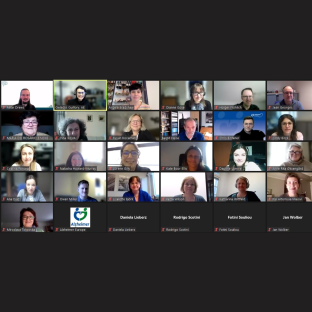
On 24 January 2023, Alzheimer Europe held an online Alzheimer’s Association Academy session, focused on the topic of ‘Artificial intelligence in dementia research’. The event featured presentations from four speakers and was attended by 61 participants. Angela Bradshaw (Project Officer, Alzheimer Europe) was the moderator for the session.
In his presentation, Ainar Drews (Oslo University, Norway), provided some information about the AI-Mind project, of which he is the technical coordinator. AI-Mind is focused on the development of Artificial Intelligence (AI) tools for the early risk assessment of dementia. This project is now organising a large-scale clinical study with approximately 1,000 people with Mild Cognitive Impairment (MCI) across Europe. Ainar mentioned that this large amount of data cannot be digested by humans alone, which is why AI is needed. Ainar defined AI as a broad term that refers to machines performing tasks associated with human cognition. Within this field, there are specific subfields of AI, such as machine learning (which is characterised by the use of specific rules, namely algorithms that can learn through or without human supervision) and deep learning, which is a subset of Machine Learning (ML) where the algorithms mimic the way the human brain processes information. Ainar then discussed the different types of uncertainties in AI. He mentioned the epistemic uncertainty, which is due to the limitations in the quality of data used to train algorithms, and the aleatoric uncertainty, which is due to real, natural stochasticity (i.e. random error) in the data. Deep learning algorithms can also be vulnerable to malicious input and may also take the easiest path to success, which is not what we would expect from humans. He finished his talk by explaining that many of the challenges faced by AI become (almost) non-issues when: 1) the scope of the problem for which AI is applied for is properly selected for and, proper care is taken to both identify and quantify confidence in output, 2) training data is carefully selected and 3) one does not use the AI system if it can't be proven to perform as desired.
The following speaker was Petra Wilson (Health Connect Partners, Belgium). The emphasis of her presentation was on the use of health data for artificial intelligence, on EU data regulation/policy and the concepts of data ownership and altruism. Despite the huge potential for AI to improve health, she emphasised that there is a fear that the data collected to develop AI-based tools will be misused – the General Data Protection Regulation (GDPR) enables the creation of rules for data sharing which ensure the protection of privacy. The EU Data Governance (DGA) created the concept of data altruism and bodies that can support the trusted sharing of personal data. She also mentioned the European Health Data Space (EHDS), which recognises the special needs of releasing data for healthcare and research, and the importance of trust in handling sensitive data. She discussed the concept of ownership which implies legal and emotional aspects which may not be the most relevant or useful when talking about health-related data sharing. Petra concluded her presentation by stating that health can be made more ethical if data governance is in line with health data seen as a public good. She referred to WHO’s call to member states and other stakeholders to work together to develop good data governance practices underpinned by a globally unifying set of principles of effectiveness, ethics and equity.
In the next presentation, Dianne Gove (Director for Projects at Alzheimer Europe) focused on presenting the ethics and Public Involvement/stakeholder work involved in the AI-Mind project and laying out some of the key ethical issues that were identified. Alzheimer Europe (AE)’s task in the AI-Mind project was to engage in ethical reflection about the use and communication by clinicians in the clinical setting of AI-based risk prediction tools. One of the main goals of the work was to enhance the trustworthy use and communication of AI-based dementia risk prediction to people with MCI. This then led to the drafting of a strategy (or guidelines) to enhance trustworthy communication of AI-based dementia risk predictions. Dianne then discussed some of the different topics that emerged from her literature review and the various consultations with people with dementia and MCI and with clinicians. These included: trust and trustworthiness, impact on clinical practice, understandability and explainability, accountability/responsibility, bias, communication of AI-based dementia risk prediction and broader societal impact. Dianne concluded her presentation by stating that the potential use of AI-based dementia risk prediction in clinical practice is likely to be met with a range of attitudes and expectations from patients, their families and clinicians. The strategy to guide the future implementation and communication of AI-based dementia risk prediction tools should be further discussed with stakeholders once the tools are in use.
The final speaker was Holger Fröhlich (Fraunhofer SCAI, Germany). In his presentation, Holger explained why treating pathologies such as Alzheimer’s disease (AD) still remains a challenge. The underlying disease mechanisms are not fully understood, and might also differ from patient to patient. This translates in difficulties to diagnose early in the disease progression, and developing and treating patients with innovative and effective disease-modifying drugs. Holger then discussed four current trends researchers focus on to address this problem: earlier diagnosis, stratification, prognosis and monitoring and care. Holger emphasised that during their journey, patients are generating lots of data (e.g. brain scans, CSF biomarkers, lifestyle and demographic information, cognition tests, neuropsychological examination, etc.) that are very useful for better understanding the early diagnosis, stratification, prognosis, and monitoring and care. Although this large amount of data cannot be digested by humans alone, it is possible for AI to turn this data into decision support for patients, doctors and caregivers. Holger then concluded his presentation by giving some examples of the use of AI in European dementia research projects (e.g. RADAR-AD, ADIS), where AI and machine learning algorithms have been used to determine a person’s individual risk of progressing from the MCI stage to dementia, and symptom progression.
