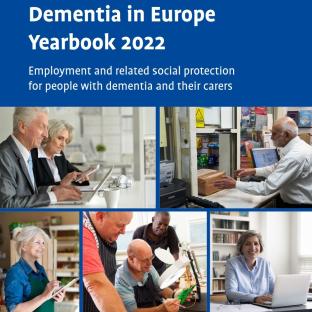
Luxembourg, 30 January 2023 – Alzheimer Europe has today launched its 2022 Dementia in Europe Yearbook dedicated to employment and related social protection for people with dementia and their carers. The Yearbook examines the overarching European and International accords which protect people with dementia and their carers in relation to employment and social protection, as well as examining the approaches to policy and legislation taken by countries across Europe.
The Yearbook provides an overview of the provisions of the Charter of Fundamental Rights (CFR), the European Pillar of Social Rights, the United Nations Convention on the Rights of Persons with Disabilities (UNCRPD), as well as examples of EU legislation and policy initiatives in the area of employment and social protection. The Yearbook found that the rights of persons with dementia were well articulated in this regard (as a disability), whilst carers’ rights were less specifically acknowledged. Across European countries, policies and legislation related to employment and social protection vary considerably. Of the countries with a dementia strategy, only a small number contained references to employment or social protection for either people with dementia or carers, whilst others reported relevant policy drivers in the areas of older persons, disabilities or employment, which included resources and schemes relevant to persons with dementia. Despite the considerable differences in social protection systems between countries, common criticisms emerged. These included the overly complex structures of systems, restrictive eligibility criteria and insufficient levels of financial support provided. For people with dementia, few social protection systems considered the specific nature of dementia as a progressive and life-limiting condition (most measured against the level of disability or ability to work), whilst for carers, benefits were often assessed by the level of disability of the cared-for person, not the level of care provided or the needs of the carer themselves.
The Yearbook also contains testimonies from a number of past and present members of the European Working Group of People with Dementia, as well as other people living with dementia, who shared their experiences of receiving a diagnosis of dementia whilst employed or those who accessed social protection systems. These experiences were broadly negative and illustrate that there is much work to be done to ensure that the rights of people with dementia and their carers are upheld. To this end, the conclusion of the report contains a number of recommendations aimed at both National and European decision-makers, encouraging them to take actions to improve legislation and policies around employment and social protection, including:
• The need for greater flexibility in social support systems to allows carers to continue to work (where they wish to do so)
• The development of an equivalent social scoreboard to monitor Member States compliance with the UNCRPD and CFR
• Ensuring that information, advice and support to access benefits is available in accessible formats, including “Easy Read”.
Commenting on the publication of the report, Alzheimer Europe’s Executive Director, Jean Georges, stated: “On the subject of employment and social protection, the European and International and international accords such as the Charter of Fundamental Rights, the United Nations Convention on the Rights of Persons with Disabilities and the European Pillar of Social Rights set out a strong foundation for the rights of people with dementia and carers. It is therefore disappointing to see that the policies, legislation and systems across Europe are broadly failing to uphold these rights. Despite the significant variations in social protection systems across Europe, similar barriers and problems emerge, including restrictive eligibility criteria, overly complex applications and insufficient payments.
The policy areas covered in the report are the shared competence of the European Union and Member States. Whilst we are beginning to see the EU address these issues (e.g. through the disability employment package), Member States retain the greatest ability to make the changes necessary, especially in social protection systems. We call for the EU and Member States to take concrete steps to address the shortcomings identified within the Yearbook and to adhere to the commitments they made under European and International agreements.” The full report can be accessed on the website of Alzheimer Europe at:
For further information, contact: Jean Georges, Executive Director, Alzheimer Europe, 14, rue Dicks, L-1417 Luxembourg, Tel.: (+352) 29 79 70, Fax: (+352) 29 79 72, jean.georges@alzheimer-europe.org, https://www.alzheimer-europe.org/
Notes to editors: Alzheimer Europe is the umbrella organisation of national Alzheimer associations and currently has 41 member organisations in 37 European countries. The mission statement of the organisation is to change perceptions, practice and policy to ensure equal access of people with dementia to a high level of care services and treatment options.
The 2022 Dementia in Europe Yearbook received funding under an operating grant from the Citizens, Equality, Rights and Values programme Programme. The views and opinions expressed are however those of the author(s) only and do not necessarily reflect those of the European Union or European Commission. Neither the European Union nor the granting authority can be held responsible for them.
In early 2022, Alzheimer Europe surveyed its members, asking about the policies and legislation in their countries, as well as gathering good practice examples. In particular, the survey sought to understand the extent to which current policy and legislation reflected the obligations under different European and International accords on rights related to employment and social protection. A total of 21 responses were received.
