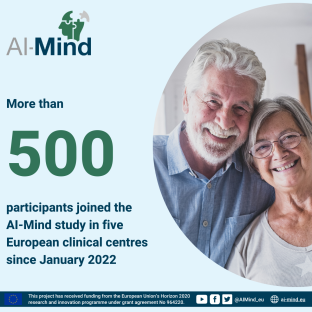
The AI-Mind consortium recently hit a significant milestone as its clinical study has already included more than half of the research participants needed to fulfil its goal. This clinical study is a key part of the AI-Mind project and will help develop and validate artificial intelligence (AI)-based tools to predict who is likely to develop dementia. The AI-Mind Connector will identify dysfunctional brain networks in an automated manner, and the AI-Mind Predictor will assess dementia risk using data from the Connector, enriched with information collected through advanced cognitive tests, and genetic biomarkers.
Recruitment started in January 2022. Out of a total of 1,000 expected participants with mild cognitive impairment (MCI), aged between 60 and 80 years, more than 550 research participants have been enrolled so far in five European clinical centres:
• Complutense University of Madrid (UCM, Madrid, Spain)
• Helsinki University Hospital (HUS, Helsinki, Finland)
• Oslo University Hospital (OUS, Oslo, Norway)
• The Catholic University of Sacred Heart (UCSC, Roma, Italy)
• San Raffaele Roma (IRCCS, Roma, Italy).
If you are interested to learn more about the study, please visit the dedicated sections on the AI-Mind website, as well as watch the explanatory video developed to inform potential participants about the AI-Mind study procedures. With the goal to distinguish people at risk and not at risk of dementia in a group of mild cognitive impairment subjects, the AI-based platform with both tools, AI-Mind Connector and AI-Mind Predictor, will be tested and validated in the above European clinical centers. We also encourage you to follow the AI-Mind social campaign dedicated to the AI-Mind clinical study on the project’s social media accounts: Twitter, Facebook, or LinkedIn. The campaign will explain in depth all the details about the enrolment process, inclusion criteria as well as the screening methods used during each clinical visit, such as the electroencephalogram (EEG), magnetoencephalography (MEG), cognitive assessment with tablets (CANTAB) and analysis of blood samples. The campaign is planned to be launched on 24th October.
This project has received funding from the European Union’s Horizon 2020 research and innovation programme under grant agreement No 964220.
