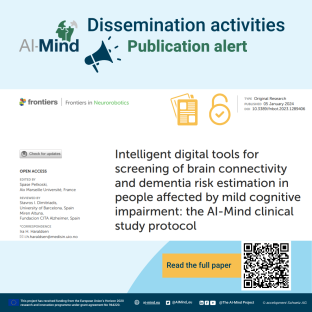
The AI-Mind project kicks off the new year with excellent news. A new AI-Mind consortium paper, "Intelligent Digital Tools for Screening Brain Connectivity and Estimating Dementia Risk in Mild Cognitive Impairment: The AI-Mind Clinical Study Protocol" has been published in Frontiers in Neurorobotics. Aligning with the European Commission's Open Science policy, this insightful paper is available in full open access. In close collaboration across diverse institutions and disciplines, the AI-Mind project introduces an innovative method for early risk assessment using advanced artificial intelligence (AI) on multimodal data. Project partners develop two AI-based tools aiming not only to accelerate the diagnostic process but also to deliver highly accurate predictions regarding an individual's risk of developing dementia when prevention and intervention may still be possible.
First, the AI-Mind Connector identifies dysfunctional brain networks through high-density magneto- and electroencephalography (M/EEG) recordings. Second, the AI-Mind Predictor utilises data from the Connector, enriched with cognitive tests, genetic and protein biomarkers, sociodemographic, and clinical variables to predict an individual's risk of developing dementia. "The AI-Mind protocol paper is a great milestone in our research journey. The many following publications from AI-Mind partners will be detail-orientated and will refer to the interdisciplinarity of the AI-Mind project. We are excited to assure the reader of a thrilling 2024 and 2025 year with new insights into the pre-symptomatic dementia identification of risk with the use of new biomarkers.", shares Dr Ira Haraldsen, the AI-Mind coordinator.
The most recent publication delves into the clinical study protocol of AI-Mind, elucidating clinical, ethical, social, and technical challenges that the project addresses. Crucially, it lays the foundation for future scientific contributions by providing insights into the background of the AI-Mind study and the potential impact of the project on dementia risk assessment. The clinical study, as detailed in the publication, is expected to make significant contributions to ongoing discussions about the clinical assessment of AI-Mind across four European countries. The AI-Mind project marks a significant milestone in leveraging AI to enhance early detection and intervention in dementia. It exemplifies collaborative efforts from experts across diverse fields, pushing the boundaries of neuroscience and artificial intelligence.
The AI-Mind project also benefits from its integration into a network of major European initiatives, including The Virtual Brain, The Virtual Epileptic Patient, and EBRAINS AISBL service for sensitive data, HealthDataCloud. Alzheimer Europe Executive Director Jean Georges, Director for Public Involvement and Ethics Dianne Gove, Public Involvement Lead Ana Diaz and Project Officer Cindy Birck are co-authors of this paper.