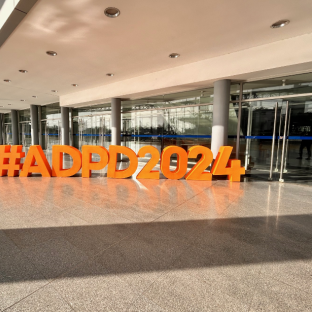
The 2024 edition of the International Conference on Alzheimer’s Disease and Parkinson’s Disease (AD/PD) took place between 5-9 March, at the Congress Center in Lisbon. With a strong focus on clinical and biomedical science, AD/PD hosted over 600 presentations across six parallel sessions, welcoming more than 4,700 on-site participants. Our Director for Research, Angela Bradshaw, attended AD/PD, and reported back on some of the scientific advances presented at the conference.
The AD/PD programme was packed with updates on disease mechanisms, diagnostics and therapeutics, on highly prevalent diseases such as AD and PD, as well as rarer conditions like dementia with Lewy Bodies, multiple system atrophy, and Huntington’s disease. While many sessions were focused on a single disease area, AD/PD also hosted sessions that combined updates from different disease areas – a great opportunity to learn about shared and distinct experiences and perspectives. As a case in point, the conference started with a fireside chat between Michael J. Fox, Ronald Lauder, Philip Scheltens and Henrietta Nielsen, bringing together PD advocacy, AD philanthropy, neurology and fundamental research.
Biomarkers, which are measurable indicators of processes happening inside the body, were a prominent feature of the AD/PD programme. With 14 sessions on the topic, no stone was left unturned: presentations covered a huge breadth of disease areas, technologies, and applications, from digital speech data to cerebrospinal fluid biomarkers. Presentations on biomarkers such as p-tau217 showed that we are inching ever closer to having validated, blood-based biomarkers that can inform the diagnosis and management of early AD. There are also promising developments for non-Alzheimer's dementias, with interesting presentations on alpha-synuclein assays for early detection and risk prediction for dementia with Lewy bodies (DLB) and studies on the TDP-43 biomarker in frontotemporal dementia and ALS. However, leading experts acknowledged that technologies and tests still need to be validated in the community setting, with clear clinical guidelines allowing doctors to choose the right test to reliably detect different types of dementia in people from different ethnic backgrounds who may have additional conditions such as kidney disease or diabetes.
On therapeutics, the majority of presentations focused on Phase 1 or Phase 2 early-stage clinical trials, or on subgroup analyses of results from blockbuster Phase 3 trials for anti-amyloid drugs lecanemab and donanemab. Roche presented new findings from their Brainshuttle AD study, a Phase 1b/2a clinical trial investigating ascending doses of trontinemab. Trontinemab combines a section of Roche’s anti-amyloid antibody, gantenerumab, with a transferrin-based “brain shuttle” that transports the drug across the blood-brain barrier. In their presentation, Roche researchers showed that treatment of trontinemab at the highest dose (3.6mg/kg) led to a rapid depletion of amyloid in the brain, with a majority of participants below the amyloid positivity threshold after 12 weeks of treatment. Although participant numbers were very small, the early safety signals appear positive.
Dementia risk reduction and brain health also featured in the AD/PD programme. A session on “prediction and prevention of cognitive decline” brought together researchers from the WorldWide FINGER programme, sharing new findings on the impact of diabetes and inflammation on cognitive decline. Cognitive reserve, a concept that describes how certain people are less susceptible to age- or disease-related brain changes, was shown to mitigate the risk of dementia – potentially influenced by genetic variants. As this emerging research field progresses, it will be interesting to learn how people can build cognitive resilience across the lifecourse, and which interventions can most effectively prevent dementia in a personalised way.
To view highlights of the 2024 AD/PD conference, visit their youtube channel here:
https://www.youtube.com/@adpdnetwork4142/videos
Read the Alzforum coverage of AD/PD: https://www.alzforum.org/news/conference-coverage/adpdtm-2024-advances-science-therapy