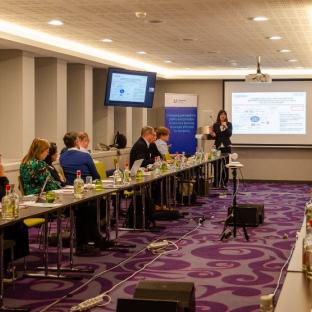
Alzheimer Europe welcomed delegates from 18 member organisations to its final public affairs meeting of 2024, which took place in Brussels on 10 December and looked at advances in detection and diagnosis and ways to promote dementia research participation. Nicolas Villain from the Sorbonne University in Paris (France) discussed the International Working Group recommendations for biomarker-based diagnosis of Alzheimer's disease (AD), detailing their new definition of AD as a cognitive-biological construct, and how that differs from the biological only definition given by the Alzheimer's Association and National Association of Ageing in the US, which leads to a different approach to diagnosing AD.
Francesca Mangialasche of Karolinska Institutet (Sweden) continued with a presentation of the AD-RIDDLE research project ‘s potential for timely diagnosis and prevention, deploying the FINGER model to address prevention as well as looking at disease-modifying treatments. She pointed out the need for tailored interventions, noting that a one-size-fits-all solution would not work, and shared about the modular toolbox they have developed that can be applied as needed for the individual. She spoke about the digital engagement portal and asked the delegates whether they thought it would be useful in their countries.
After feedback from the delegates, Angela Bradshaw, Director for Research at Alzheimer Europe, presented the current status of Horizon 2020 research which has 222 research projects involving partners in 30 countries. She noted that nine EU countries are involved in 78% of the projects and stressed the need for data sharing in dementia research. Then, Lukas Duffner, Project Officer at Alzheimer Europe, presented the objectives for and structure and timing of the research he is conducting on European perspectives on research participation and data sharing. He asked delegates for their input for translations of the study into their local languages, to support piloting and disseminating the poll, and to share what they would like to see reflected in the study.