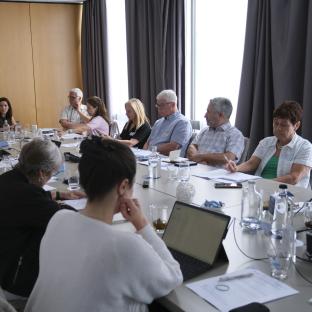
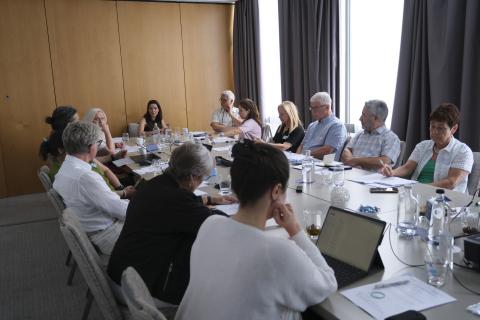
Members of the European Dementia Carers Working Group (EDCWG) travelled to Senningerberg (Luxembourg) to come together on 30 June and 1 July 2026 for two days of discussions on key topics related to dementia research, policy and care. A total of 12 members from 11 countries (Belgium, Czechia, Greece, Iceland, Ireland, North Macedonia, Norway, Slovakia, Sweden, Türkiye and the United Kingdom) took part in the meeting. Since 2022, the EDCWG brings together current and former informal carers of people with dementia from across Europe. The group contributes their lived experience to European research projects, policy development and advocacy activities, ensuring that the perspectives of carers are reflected in Alzheimer Europe’s work.
Day 1: Psychosocial support and palliative care
The meeting opened on the afternoon of Tuesday, 30 June, with a session on the DEMCAPS project (Dementia Care and Psychosocial Support interventions estimating health-economic impact). Facilitated by Faye Forsyth (Public Involvement Officer), the discussion focused on carers’ understanding and experiences of psychosocial interventions. Members reflected on the meaning of the term, how accessible such services are in their countries, and the practical, emotional and financial implications of accessing support. The group also highlighted the diverse benefits of psychosocial interventions, including improvements in wellbeing, coping strategies and quality of life for both carers and people with dementia, while noting challenges in measuring these outcomes through traditional indicators.
The second session of the day focused on updating Alzheimer Europe’s White Paper on palliative care, specifically the domain on psychosocial and spiritual support. Led by Ana Diaz (Public Involvement Lead) the session invited the working group members to review revised recommendations and share their views on the importance of emotional and spiritual support throughout the dementia journey.
Day 2: Research, policy and inclusive terminology
On Wednesday, 1 July, discussions began with the FIGARO project (FIGARO project (FIndinG Alzheimer’s disease pROgression markers by cerebrospinal fluid proteomics), introduced by Sarah Campill (Public Involvement Officer). This project explores the use of cerebrospinal fluid biomarkers, obtained via lumbar puncture, to better understand and predict Alzheimer’s disease progression. Carers exchanged views on the acceptability of lumbar punctures, drawing on personal experiences and perceptions.
The second session focused on the Dementia in Europe Yearbook 2026, which will examine national dementia strategies and policies across Europe. Owen Miller (Policy Officer) engaged participants in a discussion on policy priorities, gaps and good practices.
Following a guided visit of the Alzheimer Europe headquarters, the afternoon sessions resumed with a workshop linked to the ENSURED project (Empowering Needs-based Social Health and inclUsive care for RarEr Dementias in moderate to advanced stage), which focuses on rarer dementias. Facilitated by Faye Forsyth, the discussion explored carers’ understanding of the terms “moderate” and “advanced” dementia and their implications for research and public involvement. Members discussed the variability of dementia progression and the importance of recognising daily fluctuations in symptoms. As one member noted: “It is a good day when your loved one has a good day. It is a bad day when you see them struggle.”
The meeting concluded with a session, for the joint work involving the EDCWG and the European Working Group of People with Dementia (EWGPWD), focusing on the recognition of dementia as a disability. Dianne Gove (Director for Public Involvement and Ethics) guided discussions on barriers to participation in daily life faced by people with dementia, including societal attitudes, lack of appropriate support and environmental obstacles.
Throughout the two days, discussions were characterised by openness and mutual learning. Members shared personal experiences as current and former carers of parents and partners with dementia, highlighting both common challenges and differences shaped by national contexts and individual circumstances. These exchanges continue to play a vital role in informing Alzheimer Europe’s work and ensuring that research, policy and practice remain grounded in lived experience.
