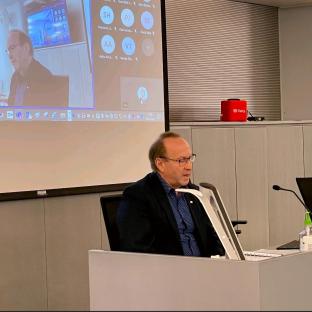
Petri Lampinen, a member of the European Working Group of People with Dementia, was recently invited to speak at a joint meeting of the divisions of the Finnish Customer and Patient Safety Association. They wanted to hear from people with dementia and about how security affects them. They had previously awarded him with a diploma and a badge of merit, in December 2021, for his work in this area and they now wanted him to speak at their event in Helsinki on 16 June 2022, at the meeting rooms of the Finnish Nurses' Union (TEHY), which he was happy to do. This is what he shared with the audience, in his speech ”Security, how does it affect me?”: The safe running of things and avoiding various incidents; a life lived without too many fears; practicing and doing the things that you can still do safely yourself; leaving out more challenging tasks for yourself; the courage to ask other people for guidance and help - When I was a kid and young man, I didn’t pay any attention to these things. In retrospect, I am horrified by the dangers there were in childhood. A familiar family doctor lived next door to us at the time, and we little boys were referred to this doctor in the event of an accident. They had a lot of medical work to do while off duty! When I was working, I took care of the occupational safety of the people reporting to me. I paid particular attention to their proper orientation. I worked as a parish gardener in my working life. When I went on sick leave, before my diagnosis with a memory disorder, I lost my sense of security for the first time in my life. When I was at home, I was afraid of doing everyday activities. I often burned my hands when I was cooking. I flinched with even the slightest noises; I was afraid the appliances would be left on. The problem of functional/cognitive difficulties related to these activities made life exceedingly hard.
Gradually, however, I began to trust myself and my ability to cope with everyday tasks. A very immense help in this situation, was my own activity, as well as developing my own means of assistance to support day-to-day tasks -not forgetting, of course, the support of loved ones. The use of a whiteboard helped me remember things and reduce the amount of noise in everyday life. So, I did not have to go from room to room to check things out anymore. My wife was left alone at work, too, I did not have to check on her so often. In the initial stages of my illness, I called her all the time. In neurological rehabilitation, I developed checklists to help me, so that no activity was left unfinished when I left the house. I also had lists with necessary items written on them, to remind me to take what I needed on any trip outside. With the use of these developed aids, the daily visits from home-care staff were able to stop. Home-care gave me, in the initial stages of the illness, a sense of security. During the visits, home-care workers checked my safety. We were living in a detached house at the time, and it was not the safest place for someone with a memory disorder to live.
Over the years, my wife and I have made joint decisions about where we live and about our type of housing. I voluntarily gave up the right to drive, as I found myself a danger to others in traffic. I was having trouble with short-term memory, so while I may have thought I was paying attention to where I was going, sometimes I was not. I am happy with the information I have about my symptoms; it helps me to understand things that I can still do safely. Driving a car is no longer going well for me and I understand this perfectly. It is for my protection and for the protection of my fellow human beings! A bicycle is good enough for me and since my diagnosis with a memory disorder, I have at least started wearing a bike helmet. Better late than never. Brain health should be nurtured in memory disorders. It took me two years to get my diagnosis. This frontotemporal dementia is not easy to diagnose. Fortunately, over the years, there has been progress in this area. Great research has been carried out in Finland and around the world, but when I was first going to medical, I noticed problems with the flow of information between specialised medical units. I was seen by many units, some of which stayed connected with each other, while others did not. I noticed these things even more clearly, from the medical records I ordered afterwards.I had noticed the constant rush that doctors and nurses were in. it was only when we entered the room that they started looking for my medical records on the computer. Appointment times were short, and another problem was the ever-changing doctors.
Suddenly, in the middle of my journey to diagnosis, they just stopped seeing me, which was a shock. I felt that the quality of medical care was far from as good as it could be and certainly not like it is on the television show Strömsö! That is why I contacted the patient ombudsman. I fought for my rights and, with the ombudsman’s help, sent a letter to the hospital's chief medical officer. I was not satisfied with his answer, so I then lodged a complaint with the Patient Injury Board. Their decision, which I liked, was that my appointments should not have stopped in the middle of my diagnostic journey. Sometimes, a little anger is good - you can take things forward in a stressful life situation. I am not bitter; I am not angry, because there is nothing to win in life by holding grudges. We all make mistakes, and we can learn from them. it is important not to worry but rather, to find positive things in life. I prepared for medical appointments in advance. I had print-outs with me, my own lists of medicines, the latest study results, my blood pressure readings and the diagnoses received. I often received praise from the staff for helping their work in this way. I still use these lists today to help me with healthcare visits. Sometimes, I left my thick, self-collected patient file to be examined by a doctor in peace, especially when they needed more time to make an assessment. I have made a small addition to the lists, which I hope will lead to a better quality of treatment. I have also posted my health data on the Finnish health data website, Kanta: https://www.kanta.fi/en/
By the time I arrive in the doctor’s office, I have openly told staff that I have a memory disorder. I am open with them about my need for help, and I am not ashamed to ask them for support. I ask them to give me instructions in writing, especially if I do not have a supporter with me, as I do not always remember the instructions given, especially when it comes to medication. Information often comes so fast that I forget about it right away. I would also ask them to check that I remember to take all my things with me and that I am properly dressed. Impulsiveness can play tricks on you, sometimes. One time, when I was living in the previous town, I left the doctor’s office without my shoes. The doctor shouted after me from the door that “your shoes stayed in the room, Petri." I would quickly have noticed the shoes were missing, but it was good to be reminded, nonetheless.I have also followed quite closely the health information that has been noted about me. A few times over the last two years, I have had to give feedback on inaccurate information. This information would have misrepresented my situation. I have managed to take care of my mother's and my father's affairs in the last three years, despite my memory disorder. My mother passed away last summer, and I had problems running her affairs. She was moved from one unit to another and often I had to be a detective to see which unit she had been taken to. These things were influenced by the same thing that I mentioned earlier: The healthcare staff is in too much of a hurry. The nurses told me quite often that it was good that I was taking it upon myself to figure these things out. A few of the units called to say that my mother had been transferred to another unit, and I thanked them for the update. I reminded them of my mother's upcoming outpatient appointments, asking whether she needed to go to them or whether to remove these visits from her calendar.
Since my mother died, my father's condition has gotten worse. He has had two bad falls this spring. Unfortunately, there have been bone fractures both times. Together with the health care staff, I concluded that it was no longer safe for him to live alone at home. Short home visits from carers a few times a day do not guarantee a safe life for him. We also made sure that he understands and accepts this, although of course it has been difficult for him. We have also been asked whether having a memory-impaired person in his close family is a security risk for my father. I have had to go through this, along with taking care of my parents' business. For example, I have had to fill out a questionnaire about my relative and when I have been open about my memory disorder, I have been asked, "Can someone else fill out the form?” In some units, the staff know me through experience and know they can rely on the correctness of the information I give. I understand that they question my ability to function, but we people with memory disorders must not all be put in the same category. People with young-onset memory disorders, who are of a working age, can still manage many things independently. I am trying everything I can to take care of security. At home, I have smoke alarms, checklists, a whiteboard, a fire blanket and first aid supplies. I also have my patient data and information about my treatment in an envelope, ready. So, if I suddenly have a medical emergency at home, the paramedics will quickly receive the necessary information. I did this because some time ago, I watched a television programme which stated that the paramedics could not access the patients’ database directly. Their superiors can, but this can take valuable time. I have functional/cognitive difficulties, and problems with attention and concentration. I might be using the wrong product or object for the wrong situation.
Last winter, we had to put distilled water in the humidifier of my CPAP (continuous positive airway pressure) device because the water where we live in Seinäjoki, is so chlorine-rich. I thought, in the store, that all the clear liquids were distilled water. When I woke up the next morning, I wondered about the whiteness of the humidifier and I felt stuffy anyway, so I went to the canister and checked the label of the product. I had accidentally bought diesel exhaust fluid. I had inhaled this all night. I was really scared and so I called the Poison Information Centre and got good instructions from them on this tricky situation. Since this event, my wife has been checking what liquid I use for my humidifier. Similar errors may occur in healthcare, whether at the doctor’s office, in a hospital or during a home-care visit. My father was given influenza and coronavirus vaccines on consecutive days, i.e. double doses. He had moved home from the inpatient ward of the hospital and the information on the vaccinations already received was not visible to the home-care worker. Or, perhaps the employee's haste affected this activity? Rushing and limited time for different things affects the feeling of security. Commotion and frightening situations in acute emergency care are exceedingly tricky situations for frail people and for people with memory disorders, as well as for the staff. I have been scared myself, sometimes as scared as a small child, even though I am an adult. It has now been seven years since my diagnosis with a memory disorder. During this period, I have not had post-diagnostic care and support that normally comes with a memory disorder. This has not created security for me and for the people I care about. Apparently, it is because I was under sixty-five. Fortunately, however, things have changed for the better recently. In our area, South Ostrobothnia, a care pathway for people with memory disorders was introduced this year, in spring. It takes into account those of us who are still working-aged and have memory disorders, as well as our loved ones. I am an expert-by-experience for the Finnish Memory Association. I am not a healthcare professional. However, I believe that I can do my bit for customer and patient safety.