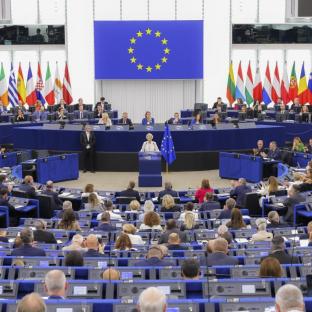
President Ursula von der Leyen’s 2026 State of the Union (SOTEU) address, delivered on 16 September from the European Parliament in Strasbourg, has set out the European Commission’s agenda for Europe, with a strong focus on security, defence, technological sovereignty and resilience. Climate change, migration, artificial intelligence and Europe’s capacity to compete globally featured prominently, alongside a proposal to open the door for Canada to become the EU’s first “Associate Member”.
The priorities laid out in the SOTEU reflect a challenging geopolitical and economic environment across the European continent and beyond. While many of these parameters will have an important bearing on health, Alzheimer Europe is disappointed to see little reference to health as a standalone political priority. This stands in contrast to 2023, when President von der Leyen presented the European Health Union as one of the major achievements of her first mandate.
For Alzheimer Europe, the declining political visibility of health is concerning. Europe’s demographic changes are continuing apace. In 2025, 99 million people in the EU were aged 65 or over, representing 22% of the population, while the working age population accounted for 63.6%. At the same time, our prevalence figures indicate that the number of people with dementia in the EU27 is projected to increase from 9.1 million in 2025 to 14.3 million in 2050, an increase of 58.1%. Dementia already carries an estimated annual societal cost of EUR221.4 billion across 30 European countries, with a majority attributable to informal care.
Against this backdrop, health policy cannot be viewed principally through the lenses of security, resilience or competitiveness. Europe also needs a direct response to the growing health and care needs created by demographic change.
There are a few positive signals from the 2026 SOTEU. During her address, President von der Leyen announced, “We will launch a European Care Deal to address the challenges linked to our demographic changes.” The accompanying Letter of Intent reinforces this point, identifying a European Care Deal for 2027.
The Commission has indicated that the Care Deal will address the affordability, accessibility and quality of care, workforce challenges, formal and informal caring and investment in care services. Alzheimer Europe hopes that care will be understood not simply as a means of increasing labour market participation or competitiveness, but as an essential part of enabling people with dementia and their informal carers to live with dignity and support.
While the emergence of a European Care Deal is welcome and highly relevant to people affected by dementia, actions on care cannot replace policies for health. Europe needs resilient, equitable and accessible health systems that can prevent, diagnose and treat disease, as well as sustainable care systems that support people affected by dementia throughout the disease course.
In 2024, President von der Leyen’s Political Guidelines committed the Commission to strengthening preventive health and stepping up work on “treatments for degenerative illnesses”, building on the model of the EU Beating Cancer Plan. There is now a clear opportunity to turn these political commitments into action. In July, Alzheimer Europe wrote to President von der Leyen, noting that the European Parliament’s SANT Committee is developing an Own Initiative Report on a Neurological Health Strategy. We called for this strategy to be included in the Commission’s 2027 Workplan, with dementia as a distinct priority area.
Such actions are consistent with the priorities expressed by European citizens. In the European Parliament’s 2026 Eurobarometer, 51% of respondents identified physical and mental health essential for quality of life, while 46% pointed to the quality and accessibility of healthcare. These findings underline the importance of ensuring that health remains visible within the EU’s political agenda, alongside security, competitiveness and resilience.
As work on the Own Initiative Report progresses, the Commission must engage with Parliament and turn political commitment into measurable change: setting a common framework for neurological health, supporting implementation and capacity building across Member States, and monitoring progress. In the SOTEU, President von der Leyen rightly recognised that demographic change requires action on care and affirmed that “in Europe, people will always come first”. That same ambition must now extend to health, so that Europe is equipped to meet the growing needs of people living with dementia and their carers now, and in the decades to come.
Read the SOTEU address: https://ec.europa.eu/commission/presscorner/detail/ov/SPEECH_26_1868
