The “Karelleion” Integrated Alzheimer and related disorders Unit of the “Apostoli” charitable organisation of the Holy Archdiocese of Athens - a member of the Panhellenic Federation of Alzheimer’s Disease and Related Disorders - reports on its approach to occupational therapy and rehabilitation of cognitive and perceptual skills of patients with dementia, using PCs with touch-screens:
Activities on computers equipped with touch-screens can be an important tool, during the therapeutic process, in order to cope with the symptoms of dementia.
There are studies that suggest and promote the use of a PC with a touch-screen by older people, which show how useful and easy it is to use this technology, especially when there is a decline of cognitive and motor skills. The touch-screen user is not just looking at the screen but interacts with it, as well.
Interactive applications on the touch-screen offer a new, creative approach to therapeutic intervention, which may enhance a person’s memory as well. Practice of the “executive” memory through technological activities, strengthens the user, helping to maintain and improve their memory’s functionality. A good level of concentration and visual-kinetic coordination is required, in the use of mouse and keyboard. In case of cognitive disorders, there is difficulty in handling it and in performing the command.
In people with dementia, the skill of learning is improved when accompanied by an action, such as a touch-screen PC.
Examples of applications:
-
Copy a drawing on the touch-screen to practice the executive functions.
-
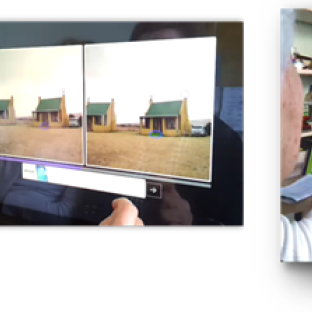
Find a difference between almost two identical photos, for exercise of attention and visual discrimination.
Observations and results:
-
All participants expressed positive feedback regarding ease of use.
-
Group sessions (groups of 2-3 people) enabled participants to interact with each other.
-
They improved their self-confidence.
-
They were creating topics for discussion, concerning this new kind of technology.
-
They were continuously improving their functional skills, in how to use the display.
-
Individual sessions improved the trust between therapist and patient.
Activities in a PC with touch-screen, may prove to be beneficial, in the following areas:
-
orientation in place and time
-
creation of a pleasant environment
-
improvement of learning skills
-
information retrieval and visual memory
-
better relationship between healer and patient
-
audiovisual coordination.