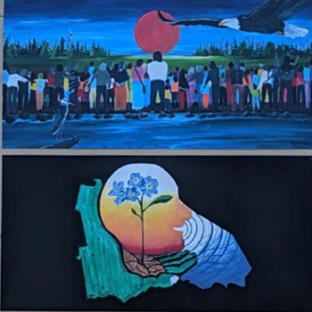
Can a dementia-friendly mural positively impact societal perceptions of dementia? Researchers Laura Garcia Diaz and colleagues sought to answer this question in their 2025 research published in the scientific journal Dementia. To answer this question, Laura Garcia Diaz and colleagues conducted participatory evaluation research looking at reactions to a Canadian dementia-friendly community mural raising awareness about dementia. The mural was developed by the collective Memory Inclusive Communities Everywhere comprising four people living with dementia. This participatory evaluation research used observations, interviews, focus groups with passers-by and stakeholders involved in setting up the mural, and social media tracking of access to the web-site associated with the mural. From their analysis of the data collected, they noticed that some members of the public were encouraged to act positively towards dementia.
The mural captured the attention of some community members walking and/or driving by it. Some community members also engaged conversations on the topic with relatives following visioning the mural. Others consulted the website linked via the QR code attached to the mural. However, the researchers noted that benefits of the community mural were modest. They triggered little to no interaction on social media, and did not lead to much interest in the work of the collective who developed the mural. According to the researchers, benefits were more akin to ‘planting a seed for increased dementia awareness and inclusion of people living with dementia’. They also noted that the process of creating the mural as a community was as beneficial as the finished mural itself. Researchers noted that a way to mitigate this limited social impact was to set up parallel community activities which complement the mural. For instance, they noted that the online community boards set up by the researchers and launched at the same time as the mural, where members of the public could write comments about their contribution to a more dementia-friendly society were a pertinent way to stimulate interest in the mural and the topic of dementia-friendly societies.
For instance, contributors to the online boards indicated that they would do at least one positive action to render their community more dementia-friendly. Therefore, to the question of whether a mural about dementia can generate positive social change, this research concludes that it depends. Essentially, the researchers explain, such a mural improves its chance of creating positive change when it is combined with other community interventions as part of a broader, holistic and multidisciplinary intervention. To create social change, they advise that a mural should be combined for instance with complementary awareness raising initiatives and community education workshops. As part of a broader community engagement strategy, such art interventions can therefore make a meaningful contribution to improving the lives of people with dementia living in the community. If you would like to know more about this research, the full scientific paper is available at: https://journals.sagepub.com/doi/epub/10.1177/14713012251333864