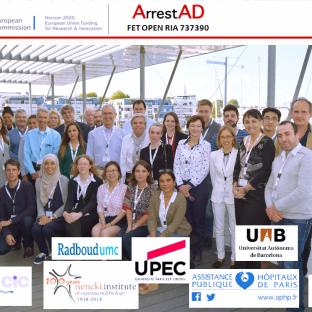
The ArrestAD programme, funded by the European Commission (FET-OPEN H2020 737390) and evaluated by Iva Holmerová, Chairperson of Alzheimer Europe, set out with the aim of understanding the central role of complex sugars called heparan sulfate (HS) in the puzzle of cascades leading to Alzheimer’s disease (AD). Since the 1990s, HS were seen abnormally accumulated inside the AD-damaged neurons. However, their roles in the disease were disregarded, possibly because of their unknown functional specificity in neurons. In 2015, a discovery of paramount importance was made by L'Université Paris-Est Créteil (UPEC), France, coordinator of ArrestAD, which showed that the HS accumulation in vulnerable neurons can induce the protein phosphorylation and aggregation observed in AD. Based on this central discovery, a completely new mechanism-based hope for preventing and arresting AD was born, with a new class of drug candidates and new blood diagnosis tools.
After five years of research, the ArrestAD project has concluded that "this new approach seems to afford the missing piece of the AD puzzle", with three mains outcomes:
• the discovery of neural HS biosynthetic enzymes as new drug targets for arresting AD and tools to discover related drugs
• several unrevealed mechanistic steps by which HS trigger protein aggregation from the synapse, until the cell dies
• a raft of diagnostic tools in blood, from the detection of HS in cells to miRNA measurement in plasma.
The researchers say that the approach they have taken in ArrestAD "fits together all known neurodegeneration cascades and affords hope for efficiently treating AD in the future". It aims to do this with the involvement of the UPEC-issued company Glycanix, which aims is to bring the ArrestAD concept to patients.
Find out more about ArrestAD, via the project website:
https://arrestad.wordpress.com/