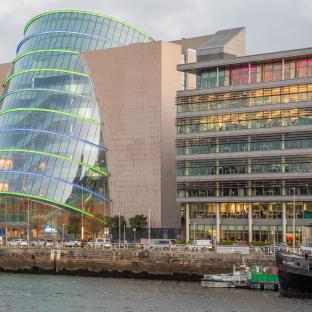
Dublin, 28 October 2026 – The 36th Alzheimer Europe Conference (#36AEC) “Sláinte: Building momentum in dementia through policy, research and partnership” was formally opened yesterday afternoon. The conference is taking place at the Convention Centre Dublin between 27 and 29 October 2026, attracting more than 1,400 delegates, with 44 countries represented. On the agenda are three Keynote sessions, three Plenary sessions, 28 sponsored sessions, six series of Quick Oral Presentations counting 69 presentations, 50 parallel sessions involving 207 presentations, and 444 Poster presentations. All our presenters are sharing their research, knowledge and experience in a warm and welcoming atmosphere of collaboration.
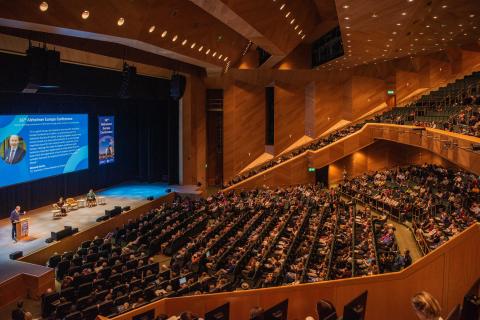
We are pleased to have the support of the Irish Presidency of the Council of the European Union to this year’s conference, offering a timely and unique platform to elevate dementia on both national and European policy agendas. We were also delighted to welcome Micheál Martin TD, Taoiseach (Prime Minister of Ireland) to the Opening Ceremony.
Bringing this prestigious event to Ireland allows us to showcase national progress in dementia care, research, and advocacy. It also is an important opportunity to connect with people living with dementia and their families, carers and supporters, as well as volunteers and staff of Alzheimer associations, policy makers, health and social care professionals, researchers, academics and industry representatives from all over Europe and beyond.
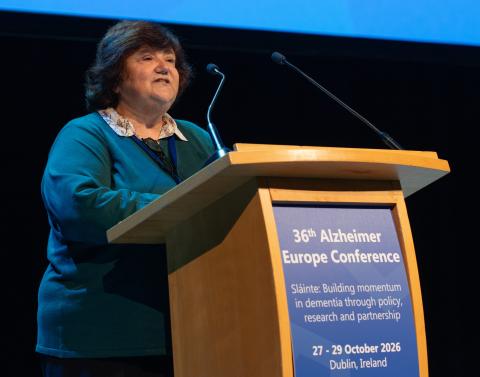
Maria do Rosário Zincke dos Reis, Chairperson of Alzheimer Europe, addressed delegates at the Opening Ceremony yesterday afternoon, officially opening the conference and saying a special word of welcome to the Prime Minister and other distinguished guests:
"We are making real progress in placing dementia higher on the European and national health, social and research agendas. Prime Minister, your presence here today sends a powerful signal of the political importance of dementia. Thank you for your commitment and dedication to our cause.
“We are also seeing encouraging advances in research, helping us to prevent dementia, diagnose earlier, develop better treatments, and provide more person-centred care and support.
“Equally important, we have transformed how we view and involve people with dementia. Their voices and experiences are essential, and I am proud that they will play an active role in this year’s conference. We look forward to listening, learning and working together."
She then thanked event gold sponsors, Lilly and Roche; silver sponsors, Bristol Myers Squibb and Siemens Healthineers; and bronze sponsors, BioArctic, Biogen, Eisai, Firalis, MSD and UCB, as well as making special mention of the outstanding partnership Alzheimer Europe has been privileged to enjoy with its conference co-host, the Alzheimer Society of Ireland.
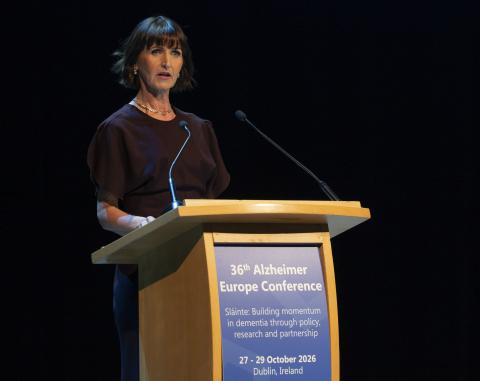
Up next was Cathy Reynolds, Chair of The Alzheimer Society of Ireland. Prior to the event, Cathy Reynolds, who welcomed delegates to Dublin. Prior to the event, she stated:
“The Alzheimer Europe Conference represents an opportunity to celebrate the longstanding and valued relationship between The Alzheimer Society of Ireland and Alzheimer Europe, which has played a vital role in advancing awareness, research, policy and human rights for people living with dementia across the continent. Through its work, Alzheimer Europe has enabled organisations to learn from one another, share best practice and advocate collectively for meaningful change.
“Ireland holds a special place in this story. The Alzheimer Society of Ireland was one of the founding members of Alzheimer Europe in 1991 and remains deeply engaged with the organisation today. The spirit of collaboration that has defined this relationship is at the heart of the conference.”
She looked forward to “an inspiring and engaging conference in exchanging ideas sharing experiences and building partnerships that will help improve the lives of people living with dementia and their families across Europe.”
“Hosting the Alzheimer Europe Conference in Ireland” she continued “is a significant milestone for The Alzheimer Society of Ireland and for the wider dementia community. It provides us with an opportunity to showcase progress, learn from colleagues across Europe and help shape the future of dementia care and support. Most importantly, it ensures that people living with dementia and their families remain at the centre of the conversation. We see hope every day in the resilience of people living with dementia, the dedication of family carers and the commitment of researchers, healthcare professionals, advocates and policymakers working to create a better future.”
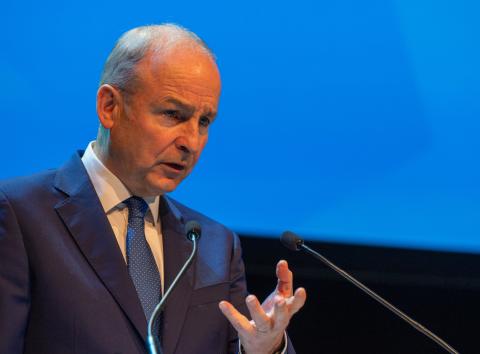
Following Cathy Reynolds’ words of welcome, Micheál Martin TD, Taoiseach / Prime Minister of Ireland took the floor, to welcome delegates, and to offer his support for the Alzheimer Europe Conference. In a press release from The Alzheimer Society of Ireland, ahead of the event, the Taoiseach said:
“It is a great honour for Ireland to host the 36th Alzheimer Europe Conference in Dublin, in partnership with The Alzheimer Society of Ireland, bringing together people from across Europe at a time when dementia is an increasingly important issue for Irish society and for countries across Europe.
“The growing number of people living with dementia is something we need to plan for as our population ages. We need to ensure that our support and services continue to respond to people’s changing needs, enabling people with dementia to live well and independently for as long as possible, while also providing the right support for families and carers.
“Hosting this major European conference gives Ireland an important opportunity to show leadership and learn from the experience of our European partners as we consider how best to respond to dementia in the years ahead. I look forward to welcoming delegates to Dublin and to seeing Ireland play its part in improving the lives of people with dementia and their families, both here at home and across Europe.”
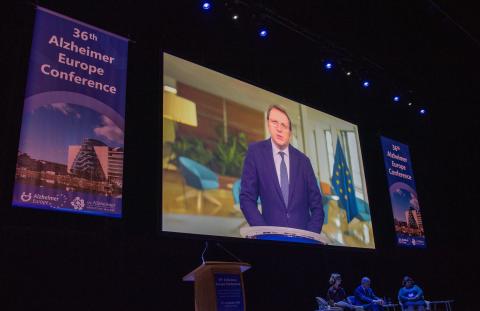
Olivér Várhelyi, European Commissioner for Health and Animal Welfare, spoke to delegates via video message. He began by thanking Alzheimer Europe and the Irish Presidency for bringing this important discussion to Dublin.
“Alzheimer's disease and other forms of dementia can have a devastating impact on patients as well as their loved ones, caregivers and communities, and those effects are also felt within healthcare systems and in wider society”, he said, also noting that “The European Commission is taking action to address these challenges under the Healthier Together initiative. We support cooperation between Member States and civil society on mental health and neurological diseases.”
He gave the example of the Joint Action on Dementia and Health, supported by the EU for Health programme, and stressed that, “as part of the Commission's comprehensive approach to mental health, we launched the European Partnership on Brain Health, aiming to strengthen brain research and help translate scientific discoveries into better prevention, diagnosis and care.”
He also noted, however, that prevention alone was not enough, highlighting the reforms made to the EU's pharmaceutical legislation, “in order to better support innovative medicines, addressing unmet needs, including dementia related conditions, while also improving patient access.”
“Tackling the challenges around Alzheimer's and dementia needs us all to work together. Public authorities, researchers, health professionals, carers, civil society, and people with lived experience. This conference is an opportunity to build strong partnerships and take our joint work forward.”
Building momentum in dementia through partnership
Our conference in Dublin marks the final one during the tenure of our Executive Director, Jean Georges, who will be retiring at the end of 2026. After 30 years leading Alzheimer Europe from strength to strength, he gave the first Keynote speech at this year’s conference, taking delegates through his time with our organisation, looking back at the many highlights and milestones.
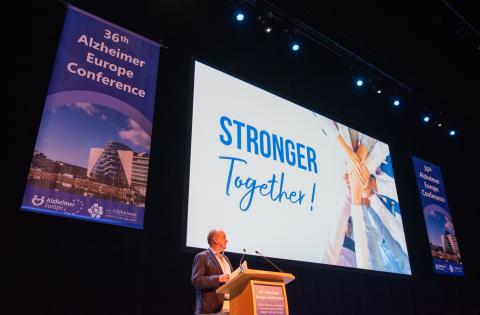
“Our conference theme, Building Momentum in Dementia Through Policy, Research and Partnership, is particularly meaningful to me”, he began, noting that his presentation would focus on the importance of partnership, during his time at Alzheimer Europe.
He shared a number of milestones, including the beginnings of the organization, in 1990, when three pioneers in the field of Alzheimer’s disease, Franz Baro (Belgium), Michael Coote (Ireland) and Henk ter Haar (Netherlands) held a meeting in Leuven (Belgium), and founded Alzheimer Europe. The growth and success of the organisation were made possible only through partnerships, and he stressed that it was only through the support of our national member associations, collaboration with European and national policymakers and researchers that we have been able to achieve so much. He drew particular attention to our longstanding partnership with INTERDEM, the European network of researchers working in psychosocial research on dementia. He also mentioned the importance of support from corporate sponsors, without whom our Annual Conference would not be possible.
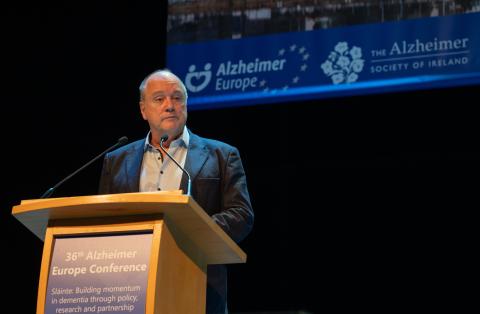
“The principles underpinning Alzheimer Europe’s very existence have remained constant throughout the organisation’s 36-year history: cooperation across borders, mutual learning, and a shared commitment to ensuring that dementia receives the recognition and political attention it deserves”, he stated. “They have shaped our identity and guided our work, placing collaboration and partnership at the very heart of our organisation. None of the past three decades of accomplishments would have been possible without partnership. Partnership with our national member associations, national and European policymakers, researchers, industry sponsors and other supporters”.
Above all, he stressed the importance of involving people with lived experience. He thanked the members, chairs and vice-chairs, both past and present, of our European Working Group of People with Dementia (EWGPWD), which was founded in 2012, and European Dementia Carers Working Group (EDCWG), founded in 2022. “I believe that this human dimension, this collective voice and this commitment to shared decision-making are among the things that set Alzheimer Europe apart.”
Looking to the future, he said: “There is still much to do. We must ensure that progress in research translates into equitable access to diagnosis, treatment, care and support. We must continue to challenge stigma and discrimination, protect the rights of people living with dementia and make sure that no country or community is left behind.”
He thanked the Board and Chair, as well as past board members and chairs of Alzheimer Europe and its dedicated team. He also took a moment to wish his successor, Angela Bradshaw, all the best in the role of Executive Director – a role which she will take as from 1 January 2027. “Angela will be taking on this responsibility at an important moment in our history”, he said. “And I am confident that, with her leadership and the commitment of the Board, staff, members and partners, Alzheimer Europe will continue to grow, develop and build on the foundations we have established together.”
With the importance of partnership and collaboration as his primary message, he ended by reminding everyone, “we are stronger when we work together.”
Parallel sessions
Following the opening ceremony and keynote lecture, delegates had the chance to join one of ten parallel sessions, including one organised by our co-host, The Alzheimer Society of Ireland entitled “Strengthening Dementia Care in Ireland - The Evolution and Expansion of the Dementia Adviser Service” and one held by the INTERDEM Academy called “Publish or Perish? Navigating Dementia Research”. Other sessions included “Artificial Intelligence” (moderated by Cindy Birck, Research Lead), “Dementia & Society” (a series of Quick Oral Presentations, moderated by Trevor Salomon, Chairperson of the EDCWG), “Towards equitable prevention: tailored initiatives and population-level risk reduction” (organised by DEMPACT), “National Leadership, service transformation and dementia diagnosis in Ireland” (organised by HSE - Health Service Executive, Ireland), “Dementia Strategies” (moderated by Owen Miller, Policy Officer), “People with dementia” (moderated by Ana Diaz, Public Involvement Lead), “Assistive technologies” (moderated by Wijnand Ijsselstein, Eindhoven University of Technology, Netherlands), and “Dementia inclusive initiatives” (moderated by Lorène Gilly, Honorary Secretary, Alzheimer Europe Board).
Following a short break, a further ten parallel sessions were held, including one by The Alzheimer Society of Ireland, called “Navigating the Journey: Empowering Family Carers Through Education, Empathy and Holistic Support – Key impacts and a Roadmap for the Future”. Other sessions included “Brain health & prevention” (moderated by Lukas Duffner, Project Officer), a series of Quick Oral Presentations focusing on policy (moderated by Christophe Bintener, Info-Zenter Demenz, Luxembourg), “The future of brain health starts earlier: First experiences from PREDICTOM” (organised by the PREDICTOM project), “Connecting the dots in young-onset dementia: from brain research to family support” (organised by DEMPACT), “Irish Rail & Irish Dementia Working Group” (organised by Irish Rail), “Advocacy & campaigns” (moderated by Ieva Petkuté, director of Dementia Lithuania), “Young Carers” (moderated by Soraya Moradi-Bachiller, Public Involvement Officer), “Psychosocial interventions” (moderated by Marjolein de Vugt, Maastricht University Medical Center, Netherlands), and “Stigma and discriminations” (moderated by Faye Forsyth, Public Involvement Officer).
Welcome reception
To close day one of the conference, a Welcome Reception was held at the Convention Centre Dublin from 18.30 to 20.00. This was an opportunity for delegates to network but also to relax after a busy day, with welcome words coming from Andy Heffernan, CEO of The Alzheimer Society of Ireland, who wished everyone “Céad míle fáilte", a traditional Irish expression that translates to "a hundred thousand welcomes". This was also an opportunity for us to thank our Executive Director Jean Georges for 30 years of hard work and dedication to our cause.
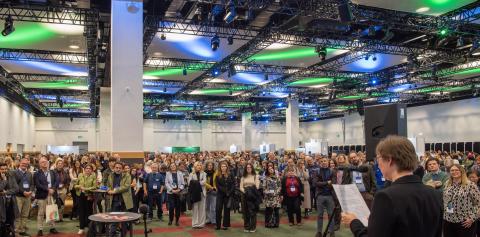
Deputy Executive Director Angela Bradshaw invited to the stage our Chairperson, Maria do Rosário Zincke dos Reis, Chairperson of the Alzheimer Europe Foundation, Heike von Lützau-Hohlbein, Chair of the European Working Group of People with Dementia, Kevin Quaid, and Dianne Gove, Director for Public Involvement and Ethics, to share some memories of working with Jean and the gratitude of the Board, Foundation, working groups and staff of Alzheimer Europe.
Ancillary meetings
A number of ancillary meetings took place in Dublin, prior to the conference.
European Group of Governmental Experts on Dementia meets in Dublin, prior to #36AEC
The European Group of Governmental Experts on Dementia held an in-person meeting on 26 and 27 October in Dublin, Ireland, in advance of #36AEC. 19 European countries were represented at the meeting Austria, Belgium (Flanders), Czechia, Estonia, Finland, France, Germany, Iceland, Ireland, Luxembourg, Malta, Netherlands, Norway, Poland, Serbia, Slovenia, Sweden, Switzerland and United Kingdom (Scotland), in addition to representatives from JADE Health, the Organisation for Economic Cooperation and Development (OECD) and from Alzheimer Europe.
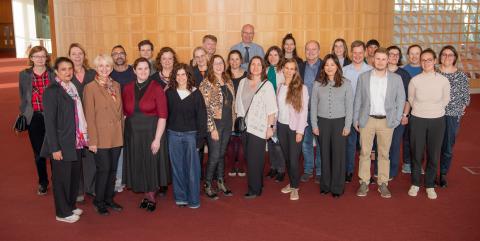
Over the course of the two-day meeting, the group discussed issues relating to modifiable risk factors on dementia and population attributable factors in each country, the recent developments on access to disease modifying therapies, OECD data on care services and strategies across Europe, as well as the latest developments at an EU and international level.
National member organisations gave updates on the recent developments in their countries, primarily focused on dementia strategies, including a new national dementia strategy in Iceland and the development of a new strategy in Belgium (Flanders). Other countries provided updates on the status of the implementation of their strategies, including focuses on tools for carers, the development of dementia registries and services to support people with dementia to live well in their communities.
INTERDEM network hosts Annual Meeting in Dublin
INTERDEM is a network of researchers interested in psychosocial interventions, made up of more than 600 researchers and academics with different professional disciplines, spread across 20 countries (18 of which are in Europe). On 26 and 27 October, the INTERDEM network hosted its Annual Meeting at the Convention Centre Dublin, prior to #36AEC.
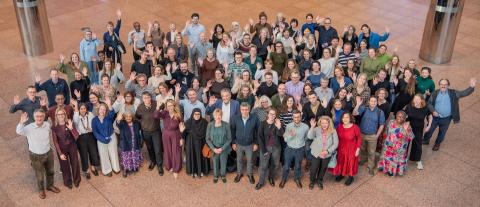
On 26 October, the meeting kicked off with a welcome from INTERDEM Chairperson Marjolein de Vugt, to all researchers present, before a presentation by Prof Kate Irving from Dublin City University on “Ethics of Care: Vital importance in supporting a person living with dementia”.
Following this, a workshop, titled “Diversity in research – Perspectives, Challenges, and new Insights” was haired by Clarissa Giebel and Martina Roes, with presentations by Hannah Christie, Shadreck Mwale and Orii McDermott. The first day closed with a business meeting and a group dinner.
On day two of the INTERDEM Annual Meeting, three taskforce meetings explored topics such as Social Health, Dementia Education and Training, Young Onset Dementia, Intersectionality, Prevention, Palliative and End of Life Care, Methodology, and Assistive Technology.
The meeting was rounded out with the presentation of the INTERDEM Academy award, chaired by Sara Bartels. Joint first place for the Award went to Jacoba Huizenga and Electra Chatzidimitriou. Congratulations to both of them!
Alzheimer Europe is proud to be a key partner of INTERDEM.
European Working Group of People with Dementia and European Dementia Carers Working Group participate in pre-conference meetings
On Monday 26 and Tuesday 27 October, the European Working Group of People with Dementia (EWGPWD) and the European Dementia Carers Working Group (EDCWG) travelled to Dublin (Ireland) for in-person meetings, prior to the 36th Alzheimer Europe Conference (36AEC). During the meetings members discussed key issues currently being addressed through Alzheimer Europe’s project and operating grant work.
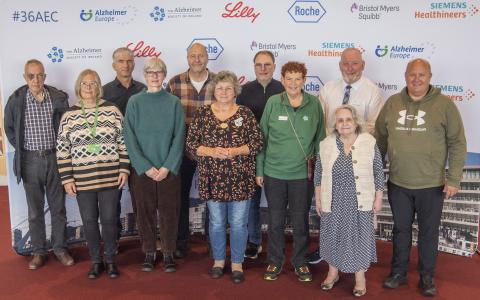
On day one, the EWGPWD reviewed Alzheimer Europe’s 2026 Yearbook which focuses on national dementia strategies and policies across Europe. The group also contributed to the DEMCAPS project (Dementia care and psychosocial support interventions estimating health-economic impact to support access and implementation in practice), reflected upon dementia as a disability and provided feedback on the “Journey Companion App”, which is being developed in the AI4HOPE (Artificial Intelligence Based Health, Optimism, Purpose, and Endurance in Palliative Care for Dementia) project. On day two members received feedback from researchers on an ongoing project focused on comorbidities, and they contributed their perspectives on advanced dementia.
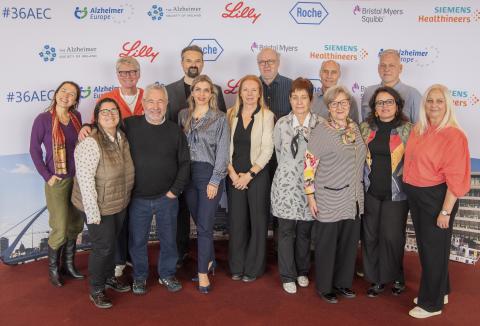
Members of the EDCWG similarly discussed the pending Yearbook, provided their reflections on dementia as a disability and advanced dementia, and supported AI4Hope researchers to progress the Journey Companion App. Their views on two European projects, ENSURED (Empowering needs-based social health and inclusive care for rarer dementias in moderate to advanced stage) and PREDICTOM (Prediction of Neurodegenerative Disease using an AI driven Screening Platform), were also sought.
The pre-conference meetings were highly productive, and all parties left with new insights and ideas to drive change in their respective fields.
Alzheimer Europe would like to extend a warm welcome to all delegates and remind everyone to use the hashtag #36AEC to join/follow the conversation on our social media channels (Live posting on BlueSky, daily posting on Facebook, Instagram and LinkedIn)
Acknowledgement
Alzheimer Europe gratefully acknowledges the support of all conference sponsors, with particular thanks to Gold sponsors, Lilly and Roche; Silver sponsors, Bristol Myers Squibb and Siemens Healthineers; and Bronze sponsors, BioArctic, Biogen, Eisai, Firalis, MSD and UCB.
